Part 2 of 3: Part 1 covered how fast GenAI use is growing among math and science teachers and how limited student use remains. This part looks at how teachers view GenAI’s effect on student learning.
Teachers are using GenAI in their own work while remaining more cautious about bringing it into student work. That gap does not tell us whether students are using GenAI on their own.
That’s one of the throughlines in Adopted but Unstructured, the second-year survey of 1,011 K-12 math and science teachers from the AmplifyGAIN Center at the University of Washington, with WestEd and Colleague AI, fielded through RAND’s American Teacher Panel. The numbers on how teachers feel about the technology align with how they’re keeping it at arm’s length from their students.
Teachers Are Split, and Views Track With Use
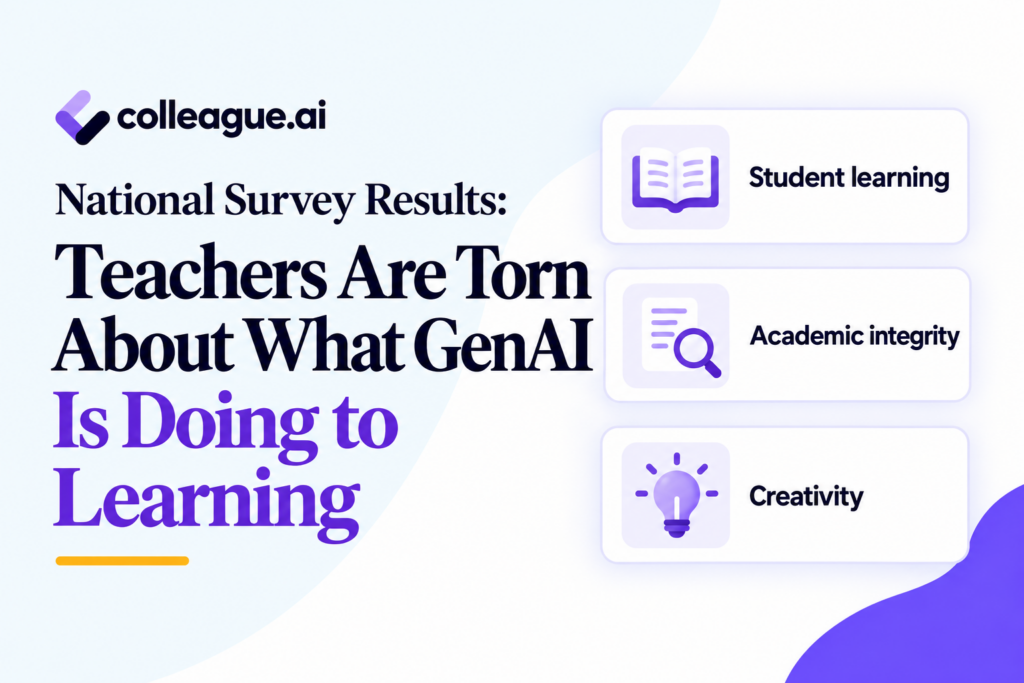
Asked whether GenAI is helping student learning, 29% of teachers said it is having a positive effect and 32% said negative. The remaining 39% rated its effect neither positively nor negatively. Positive and negative views are nearly evenly split, with a substantial share of teachers taking a neutral position.
The report also finds that teachers who use GenAI more frequently tend to view its impact on student learning more positively. This is an association, not evidence that using GenAI causes those views.
Academic Integrity Is the Loudest Worry
Sixty percent of teachers rated GenAI’s effect on academic integrity negatively, the largest negative share among the student-learning areas measured. For a math or science classroom, this concern can take familiar forms: a solved problem set that reads a little too clean, or a lab write-up with reasoning the student cannot reproduce.
This is arguably a pedagogical challenge as much as it is one about cheating or new cheating tools. Beyond integrity, teachers’ concerns center on learning itself. Student over-reliance on GenAI is one of the two most widely held concerns, cited by more than 60% of teachers.
A Deeper Worry: What Happens to Creativity
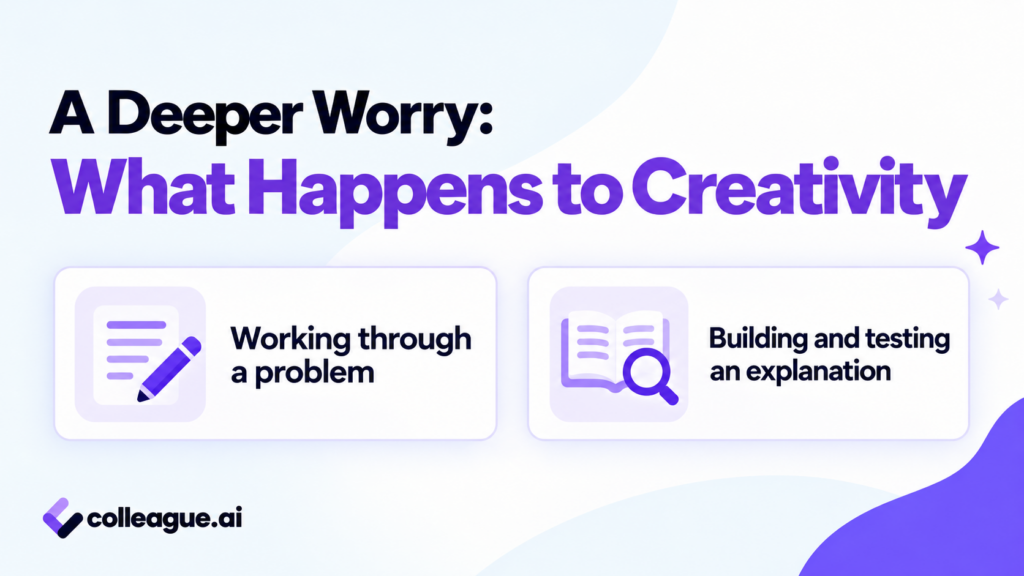
In addition to the integrity concern, there is also one about creativity: 67% of teachers worry GenAI could replace human creativity. In math and science specifically, that thinking, working through a problem and building and testing an explanation, is not a side benefit of the class. It is usually the point of the class.
For teachers who have built GenAI into their own routines but are cautious about bringing it into student work, these findings point to uncertainty about the kind of thinking their subject is supposed to build. The survey does not establish why individual teachers make those choices. It does, however, bring attention to the challenge of using GenAI in a specific setting for a specific learning goal.
Read the full report: