A question came up during a Colleague AI conversation: could it create medic simulations for EMT students? It’s the kind of request CTE teachers will recognize. The skills are hands-on, the stakes in the field are real, and the number of emergencies a program can stage in a lab is limited by time, equipment, and the instructor’s ability to be in one place.
That question led to the EMT Simulation Lab, an interactive activity our team built with Colleague AI. It has three emergency scenarios, branching decisions, vital signs that change as students act, and immediate feedback. Here’s what’s in it, and what it suggests for CTE programs more broadly.
Decision-Making Under Pressure Needs Repetition a Lab Can’t Always Provide
An EMT student can read the protocol for a cardiac arrest and still freeze the first time a patient’s condition changes in front of them. The skill is sequencing: assess, act, reassess, adjust. Students get better at that sequence by making decisions and seeing what happens, and they need far more repetitions than a skills lab can schedule.
Staging a scenario takes an instructor, equipment, a patient actor or manikin, and class time. A simulation that runs in a browser doesn’t replace that practice. It adds rounds of practice between the sessions that can be staged, and it lets a student retry a scenario after a poor call without anyone resetting a room.

Three Scenarios, Each Built Around Choices With Consequences
Students start by entering their name and class or cohort, then pick a scenario. Chest Pain & Cardiac Arrest puts them with a 55-year-old man with crushing chest pain who needs assessment, intervention, and management as his condition deteriorates. It runs about eight minutes with six decision points. MVA Trauma & Hemorrhage involves a multi-vehicle accident victim showing signs of internal bleeding, where the goal is to control hemorrhage and prevent shock. That one takes about ten minutes and seven decision points. Anaphylaxis & Airway Crisis centers on a 28-year-old with a severe allergic reaction, asking students to manage a compromised airway and administer emergency medications in about seven minutes and five decision points.
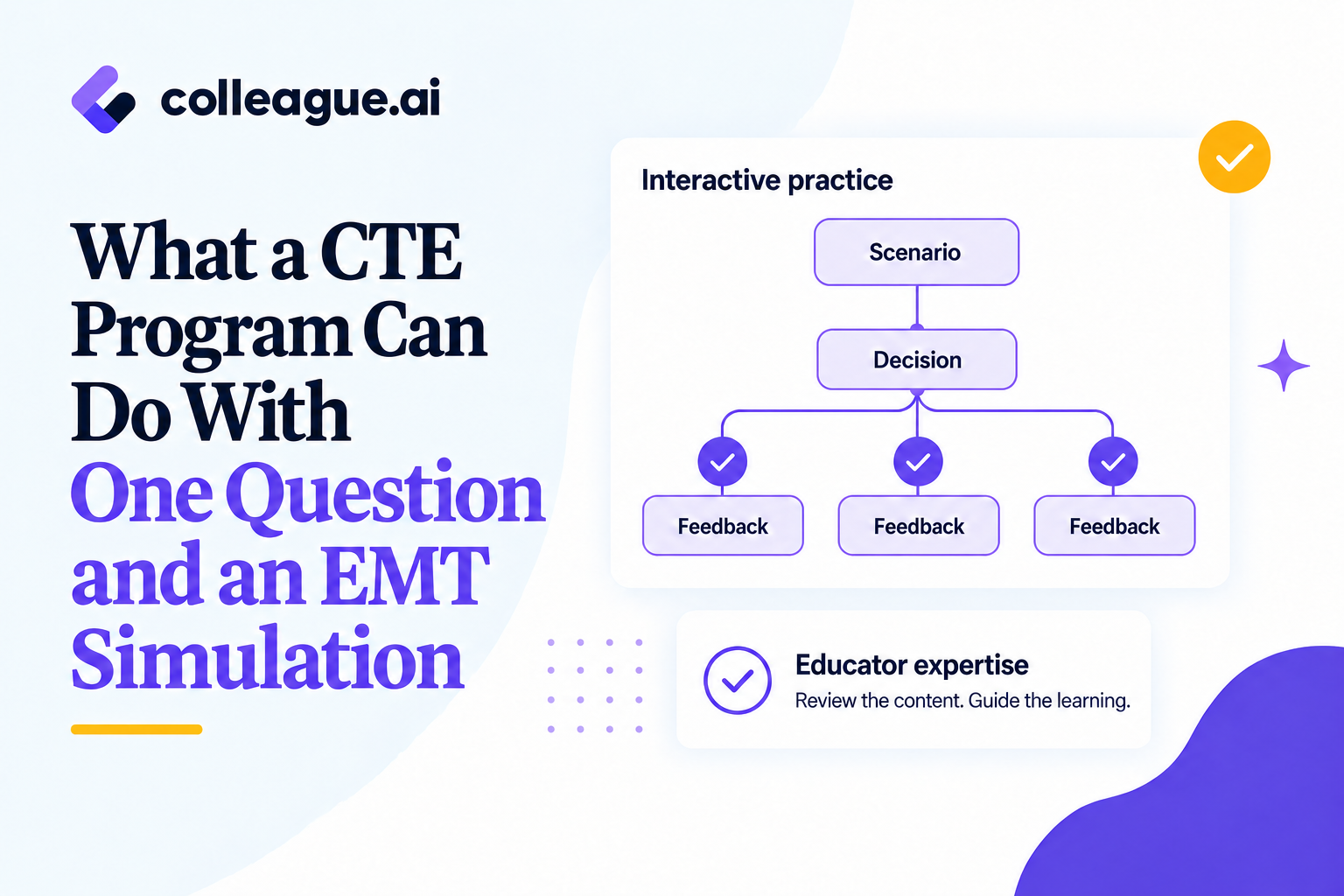
Every choice changes the patient’s vital signs, and every choice comes back with a clinical rationale explaining why it helped or hurt. A student who delays an intervention watches the numbers move. A student who gets it right sees the reasoning behind it, which is what they’ll need to repeat the decision later without the screen in front of them. Progress saves automatically, decisions are scored, and the activity can be printed.
Interactive Practice Asks Students to Act, Not Just Recall
Much of what AI produces for classrooms is static text: a worksheet, a quiz, a summary. Those have a place, but a question set about EMT protocols is also exactly the kind of assignment a student can paste into a chatbot and finish without thinking. We believe AI tools should prepare students for work where the tools exist and judgment still counts, and that means producing activities students have to engage with, not documents they can hand off.
A simulation where the patient changes in response to your choices gives students much less room to copy an answer and much more reason to think. It also fits how the work happens in the field. Paramedics and EMTs don’t answer multiple-choice questions at a scene; they make a call, watch what follows, and make another.
The origin matters here too. Nobody had to build a custom agent or chain prompts together. The request was a plain-language question from someone thinking about their students, which is the level of technical effort most educators have time for.
The Instructor Still Decides What’s Right for the Program
An AI-generated scenario is a draft. EMS protocols change over time and can vary by state and by medical director, so a scenario that reads well may still need correcting before it reaches students. The simulation itself carries a plain statement on this: it’s for educational use only and isn’t a substitute for official clinical training or certification.
The educator’s expertise remains essential: reviewing the content, checking current guidance, and deciding how the activity fits the learning goals.
An EMT instructor should review every scenario against current guidance before students ever see it. That review is also where the instructor’s judgment shapes the activity: adjusting a decision point, tightening a rationale, or deciding whether a scenario belongs in week three or week ten.
The Same Pattern Works in Any Pathway Built on Sequenced Decisions
EMT training is one example. The pattern travels to any CTE pathway where students have to make a series of decisions and live with the results. Think of a diagnostic sequence in an automotive program, a kitchen service under time pressure in culinary arts, a patient intake in a health science course, or an incident response in a cybersecurity class. Each has scenarios that are expensive, risky, or simply hard to stage often enough.
If you teach in a CTE program, the useful question is which situation in your pathway your students get the fewest chances to practice. Start there, and describe it to Colleague AI the way you’d describe it to a colleague. The EMT Simulation Lab is one answer to that question, built from a single sentence.