Part 3 of 3: Our national teacher survey series concludes with the support educators need to use generative AI thoughtfully.
An AI policy becomes useful to a teacher when it helps answer a question in the middle of the school day. Can I use this tool to adapt an assignment? What information can I enter? How should I review the material before sharing it with students?
Professional learning should help educators work through those decisions.
Adopted but Unstructured, a national survey of 1,011 K–12 public school math and science teachers, examines the training and guidance surrounding generative AI use. Its findings offer school and district leaders a starting point for planning that support.
Formal training remains limited
Fifty-eight percent of teachers reported receiving no formal GenAI training. Thirty percent reported district-provided professional development.
For a school team, providing access to an AI tool is one implementation decision. Helping educators use it appropriately requires additional work: explaining its capabilities, setting expectations and creating opportunities to practice with feedback.
A useful training session could follow an assignment from its instructional goal to a reviewed classroom resource. Along the way, teachers can discuss what they would accept, revise or reject, and explain their reasoning.

Start with the work teachers want help doing
The most requested training topics were:
- Lesson planning and materials creation: 73%
- GenAI tool basics and capabilities: 68%
- Differentiation techniques: 67%
These priorities can inform a practical professional-learning agenda.
For example, a mathematics team might bring an upcoming lesson and explore how AI could help draft alternative explanations or practice questions. Teachers would then check the mathematics, consider whether the material preserves the intended challenge and adapt it for their students.
The discussion should make professional judgment visible. What makes one explanation clearer? Does a revision support access while maintaining the learning goal? What would students need to explain to demonstrate understanding?
Privacy, accuracy and appropriate use can be addressed within those decisions.
Make time for practice and review
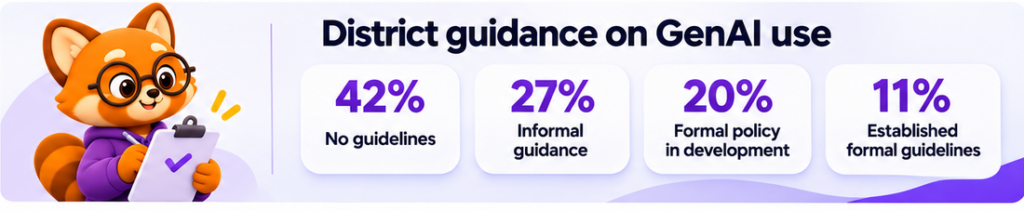
The time needed to learn GenAI was a barrier for 61% of teachers. Other barriers included insufficient training (48%), curriculum integration (43%) and unclear district guidance (39%).
A practical response is to build focused opportunities for experimentation into existing team time. Start with one task, review the output together and return to the activity after educators have had a chance to adapt it.
A department meeting might focus on reviewing generated questions. A subsequent session could examine whether those questions elicited the student thinking the teacher intended.
This gives professional learning a concrete purpose and a manageable scope. It also creates space to discuss unsuccessful attempts, including situations where an educator decides that AI does not fit the task.
Turn implementation plans into usable support
District teams can begin with three questions:
- Which instructional tasks should our professional learning address first?
- Where will educators have time to practice, evaluate and discuss their work?
- Can teachers find clear guidance when they need to make a decision?
The aim is to help educators connect AI use with an instructional purpose, exercise informed judgment and evaluate what students are learning.
Across this series, the central question remains practical: what support will help teachers make those decisions well?
Read the full report: Adopted but Unstructured
Research by Alex Liu and colleagues affiliated with the University of Washington, WestEd and Colleague AI. The survey was fielded through RAND’s American Teacher Panel.