You have 30 students in front of you.
Twelve are working about two grade levels above grade level standard. Nine are working about two levels below. The remaining students are somewhere near grade level, each with their own strengths, foundational knowledge gaps, interests, and willingness to admit they’re confused.
Tomorrow’s lesson has one grade-level objective.
You could create separate lessons for each group, assuming you want to order Uber Eats for the third time this week and miss your daughter’s soccer game. You could teach to the middle and spend the period watching some students wait while others quietly disappear from the learning.
Or you could use Colleague AI to build one lesson with three purposeful paths.
How to Create a Tiered Lesson Plan in Colleague AI
To illustrate how to tier a lesson plan, we’re going to use a specific example: let’s assume your class is beginning a seventh-grade ELA lesson with this objective:
Students will cite two pieces of textual evidence to explain how a character’s response to conflict develops a theme.
The objective stays consistent for every student. The level of access, scaffolding, text complexity, and independence changes.
Before building those paths, we need a clearer picture of where students are starting.
Optional Step 1: If It’s Early In the Year, Create and review a short diagnostic assessment
A useful diagnostic assessment gives the teacher enough information to make an instructional decision. It doesn’t need to consume a full class period; it can be short and still provide valuable information.
View step-by-step guide on how to create a diagnostic assessment.
After students complete the diagnostic, look at the data from the results and identify any patterns patterns connected to the objective.
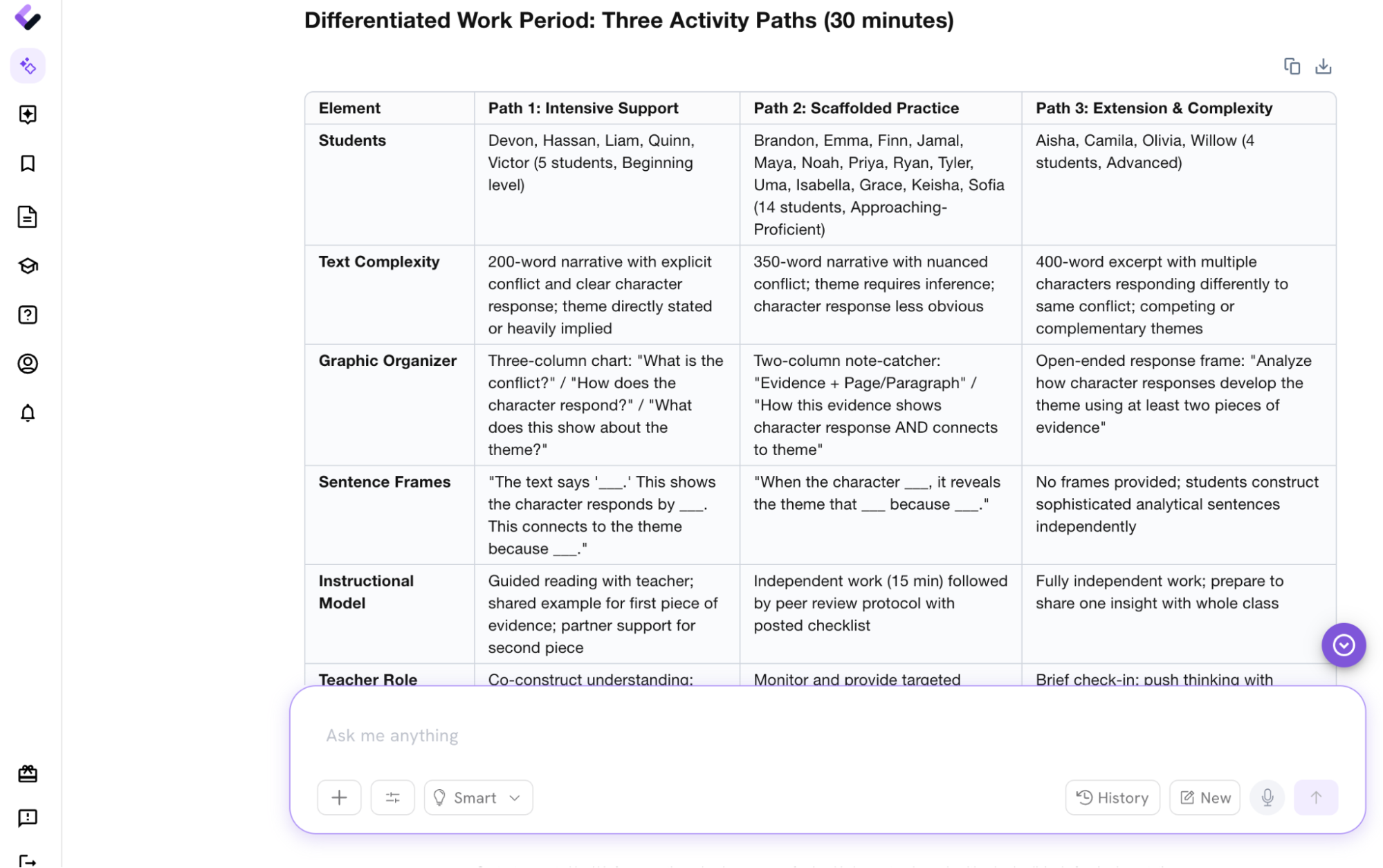
Step 2: Generate three paths toward the same objective
You can now ask Colleague AI to design the lesson structure.
Example prompt
Build a 45-minute lesson with three differentiated activity paths based on these diagnostic patterns. Every student must work toward this objective: Cite two pieces of textual evidence to explain how a character’s response to conflict develops a theme. Keep the opening and closing activities shared. Create different supports, text demands, and extension opportunities within the work period.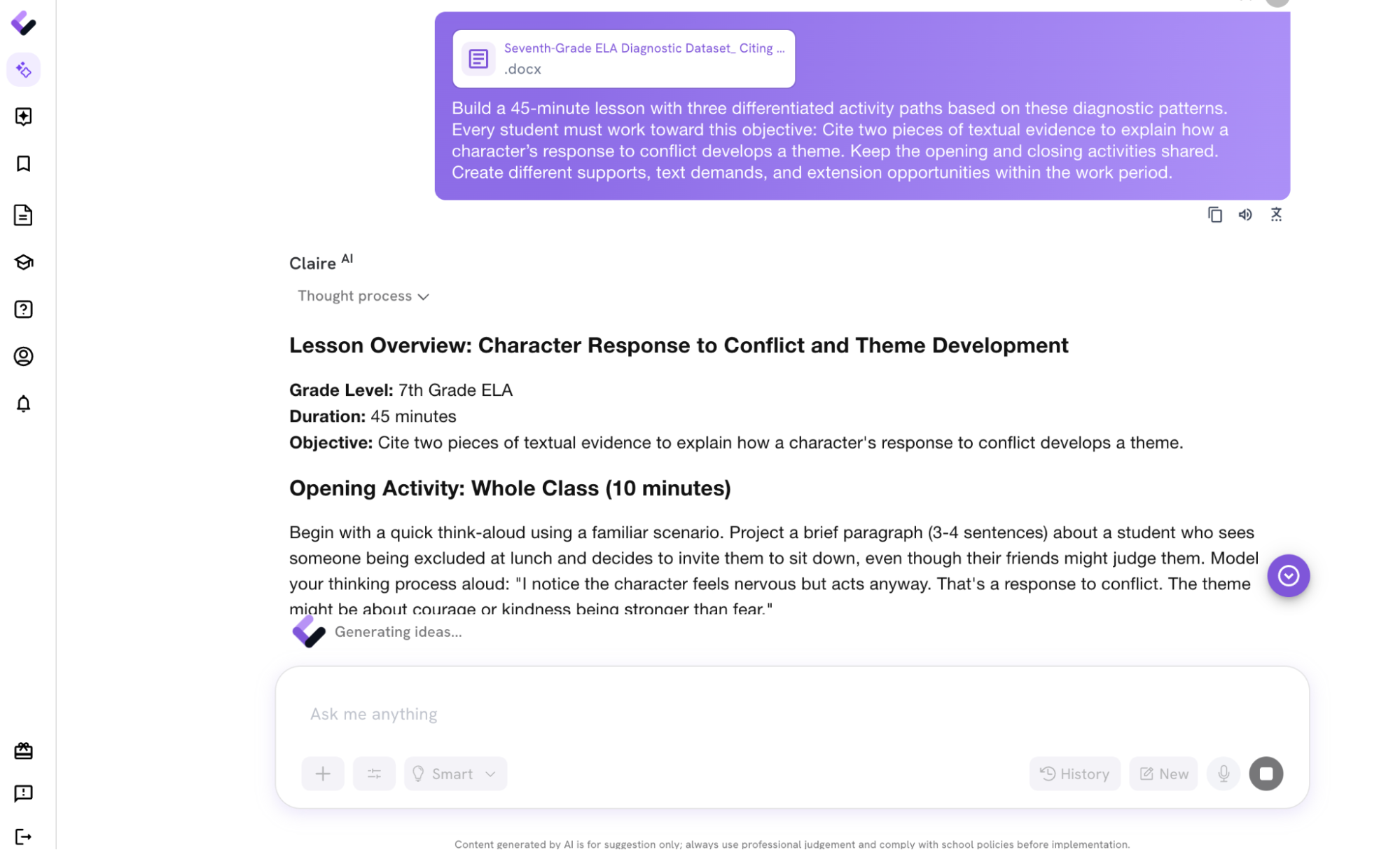
Here is what the output could look like:
The lesson structure
Shared opening: 7 minutes
The teacher displays a brief scenario:
A student sees a close friend cheating during a test. The teacher asks whether anyone noticed what happened.
Students respond privately:
-
What conflict does the student face?
-
What choice could the student make?
-
What might each choice reveal about the student’s values?
The teacher uses two or three responses to connect conflict, character response, and theme.
Every student enters the lesson through the same central idea.
Differentiated work period: 28 minutes
Path 1: Building access to evidence and explanation
Students receive:
-
A shortened, chunked version of the excerpt
-
Brief definitions beside key vocabulary
-
Three possible conflict statements
-
Highlighted sections where evidence may be found
-
An evidence-to-explanation organizer
-
Sentence frames for the written response
Student task:
-
Choose the statement that best describes the conflict.
-
Select two quotations that show the character’s response.
-
Complete the organizer:
-
The character responds by ______.
-
This shows ______.
-
This helps develop the theme that ______.
-
Combine the ideas into a short paragraph.
Sample expected response:
The character responds to the conflict by telling the truth, even though the decision may hurt her friendship. She says, “I could feel Maya watching me, but I raised my hand anyway.” This shows that the character values honesty even when honesty has a personal cost. Her response develops the theme that doing what is right can require courage.
Students complete grade-level thinking with structured access to the text and writing process.
Path 2: Applying the grade-level skill
Students receive:
-
The full grade-level excerpt
-
A theme-development organizer
-
A checklist aligned to the objective
Student task:
-
Identify the central conflict.
-
Write a possible theme statement.
-
Select two pieces of evidence showing the character’s response.
-
Explain how each piece of evidence develops the theme.
-
Write one analytical paragraph.
Student checklist:
-
I stated a theme as a complete idea.
-
I selected two relevant pieces of evidence.
-
I explained what each quotation reveals about the character.
-
I connected the character’s response to the theme.
The teacher can conference with students whose evidence is accurate and whose explanations remain broad or repetitive.
Path 3: Extending the analysis
Students receive:
-
The full excerpt
-
A short paired excerpt featuring a similar conflict
-
Two possible theme interpretations
-
An extension prompt focused on author choices
Student task:
-
Evaluate two possible theme statements.
-
Choose the interpretation best supported by the text.
-
Cite two pieces of evidence.
-
Address one piece of evidence that could support the alternate interpretation.
-
Explain how the author’s portrayal of the conflict shapes the theme.
Extension prompt:
How might the theme change if the character made the opposite decision? Use details from the excerpt to explain your reasoning.
Students remain anchored to the original objective while working with greater independence, ambiguity, and analytical demand.
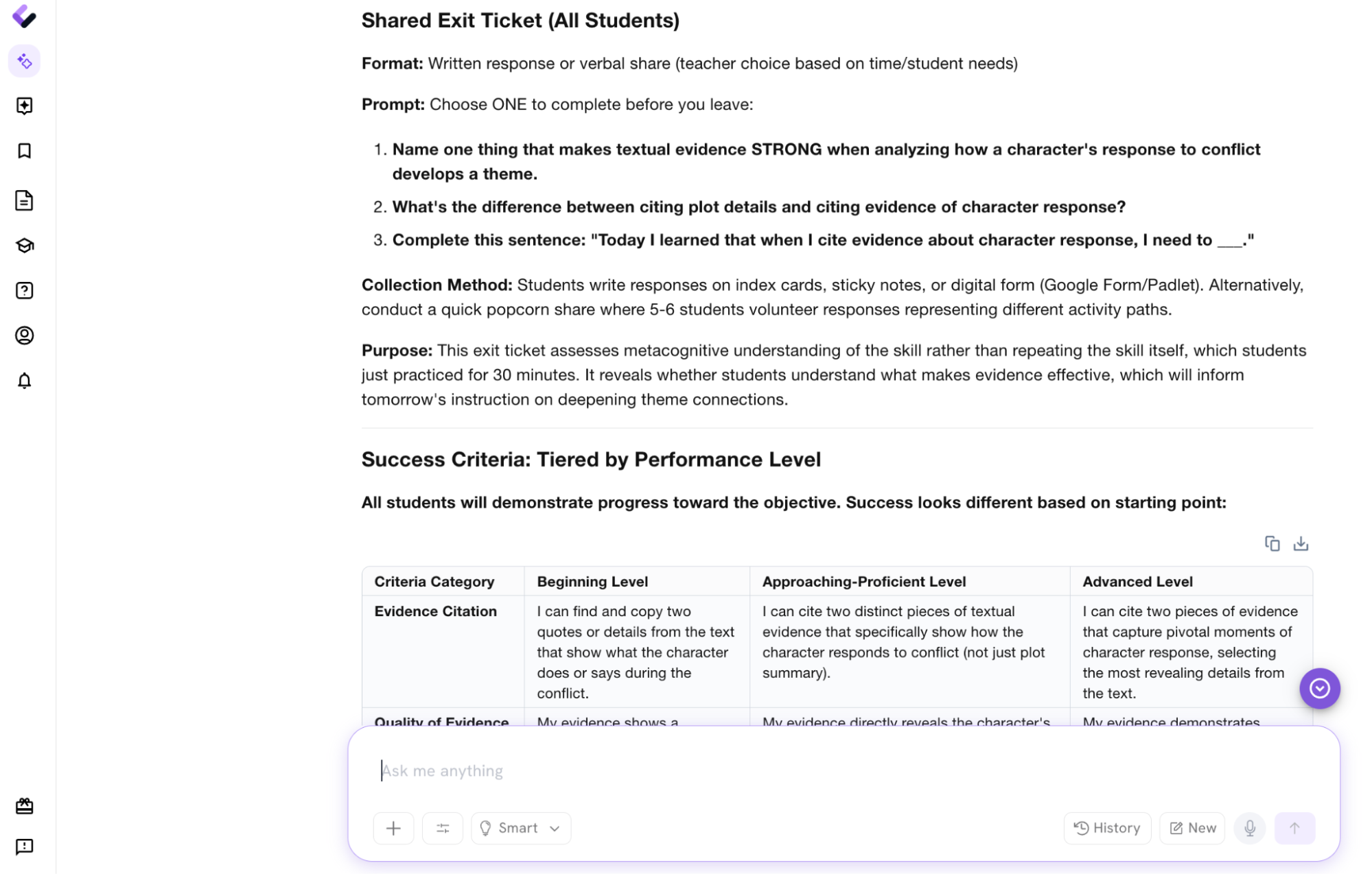
Shared closing: 10 minutes
Every student responds to the same exit prompt:
What does the character’s response to conflict reveal about the theme? Cite one piece of evidence and explain the connection.
The teacher receives work tied to one objective and one success criterion. The supports vary. The learning target remains visible across the room.
Step 3: Adjust the materials with your judgment
A generated lesson is a starting structure. The teacher can ask Colleague AI to revise individual parts without rebuilding the entire lesson.
For example:
-
“Replace the sentence frames with a visual organizer.”
-
“Add Spanish vocabulary support for the five key terms.”
-
“Make the advanced path appropriate for students working independently.”
-
“Create a version of Path 1 that can be completed with text-to-speech.”
-
“Turn the shared closing into a three-question Google Classroom assignment.”
-
“Create teacher conference questions for each path.”
The teacher can also change student groupings during the lesson. A student may need vocabulary support and demonstrate advanced analytical thinking. Another may read fluently and need direct instruction in connecting evidence to a claim.
Differentiation works best when it responds to the student work in front of the teacher.
Step 4: Use the exit ticket to plan the next lesson
The shared exit ticket creates a common source of information across all three paths.
You can ask Colleague AI to sort responses by the next instructional move:
-
Students who need more practice selecting evidence
-
Students who need more practice explaining evidence
-
Students who have met the objective
-
Students ready to transfer the skill to a new text
Tomorrow’s groups may look different!