It’s Week 4. Your students have read the text, annotated a few passages, and written responses to discussion questions.
Tomorrow’s lesson is a Socratic seminar….but there’s one problem: most of your students have never participated in one.
A few will hear “discussion” and prepare to dominate it. Others will wait quietly for you to call on them. Several students may have thoughts and no idea how to enter the conversation. Someone will ask whether this is graded before you’ve finished explaining the directions.
This is clearly a great learning opportunity for your students, each bringing different capabilities and experiences to the table. However, helping students prepare, and preparing on your own to make that happen, takes time, effort, and resources. The seminar can still work, but students need more than a circle of desks and a list of questions: they need to see what successful participation looks and sounds like before the discussion begins.
Here we share how Colleague AI can help you create a student preparation packet: discussion norms, sentence starters, a facilitation guide, and a student self-assessment rubric tied to the goals of the lesson.
Start With the Situation You Actually Have
A useful prompt gives Colleague AI the context a fellow colleague would need.
Include:
-
The grade level and subject
-
The text, unit, or topic
-
The discussion goal
-
Students’ prior experience
-
Any participation needs or classroom considerations
-
The length of the class period
-
The materials you want created
A seventh-grade ELA teacher might write:
My seventh-grade students are preparing to discuss the choices characters make under pressure in our current novel. Most students have never participated in a Socratic seminar. Create a 45-minute introductory seminar protocol that teaches students how to participate. Include student-friendly discussion norms, sentence starters, a teacher facilitation guide, and a short self-assessment rubric. Build in ways for hesitant speakers, multilingual learners, and students who need processing time to contribute.
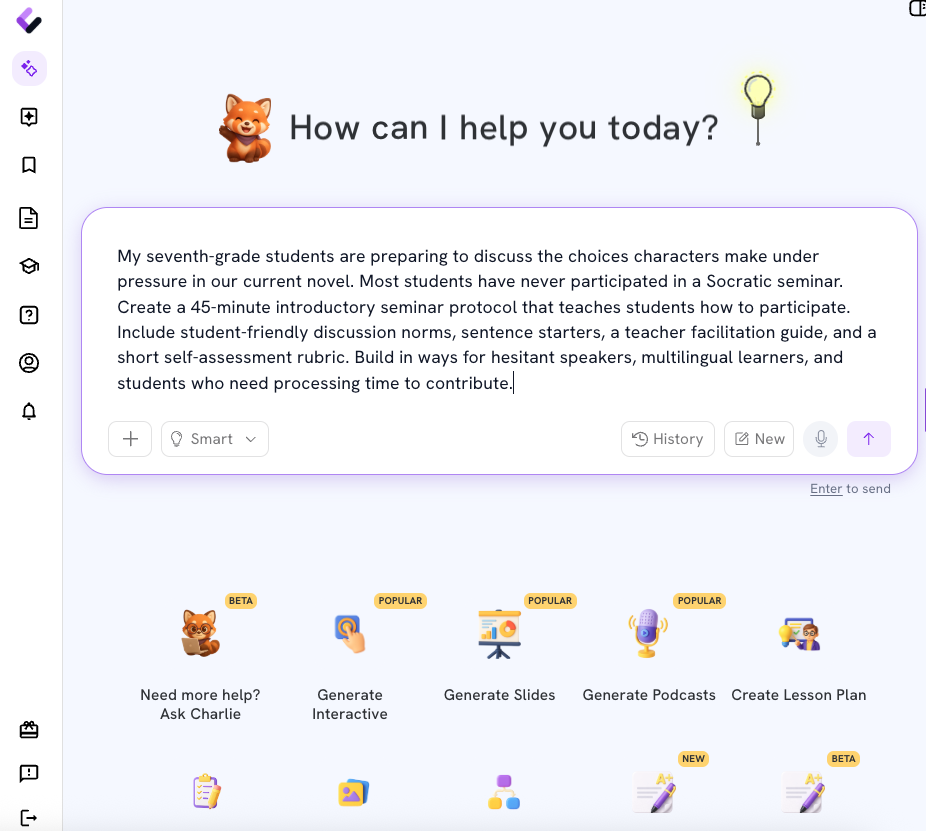
Because the prompt includes the students’ experience level, the response can teach the routine alongside the content. The teacher receives materials built for an introductory seminar rather than a protocol designed for students who already know the process.
How to Build a Socratic Seminar Assignment Using AI
1. Generate Student-Friendly Discussion Norms
Students often receive directions such as “respond respectfully” or “build on each other’s ideas.” Those directions name the goal, but students also need examples of the actions that produce it.
Use Colleague AI to generate broad expectations and specific observable behaviors or actions:.
Sample discussion norms
Our seminar agreements
-
Bring the conversation back to the text.
Point to a passage, event, or detail that supports your thinking. -
Listen for an idea you can build on.
Connect your comment to something another person has already said. -
Make room and take room.
Contribute your thinking and notice when others are waiting to enter. -
Disagree with an idea carefully.
Explain your reasoning without judging the person who shared it. -
Ask questions that help the group think.
A strong question can move the discussion forward even when you don’t have a complete answer. -
Allow thinking time.
A pause gives everyone time to process. Silence doesn’t mean the conversation has failed.
These norms give the teacher language to model, reinforce, and revisit. They also give students clear criteria for monitoring themselves during the discussion.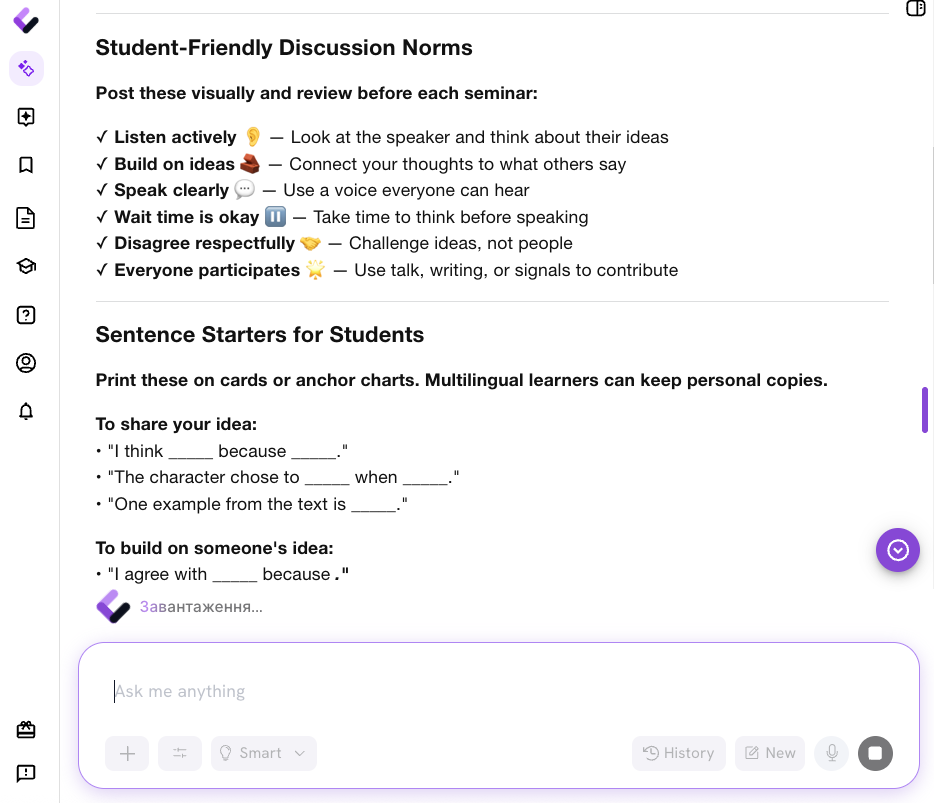
2. Create Sentence Starters Students Can Actually Use
Sentence starters can widen access to discussion when they support authentic thinking rather than turn every response into the same formula.
Ask Colleague AI to organize them by conversational purpose.
Sample sentence starters
To enter the conversation
-
I’d like to return to the idea that…
-
One detail I noticed was…
-
I have a question about…
-
I’m still working through this, and I think…
To build on someone’s thinking
-
I agree with ___ because the text also shows…
-
What ___ said makes me think about…
-
I want to add another example to that idea…
-
I see a connection between that point and…
To disagree or offer another interpretation
-
I interpreted that part differently because…
-
I see the evidence you’re using. Another possibility is…
-
Could the character’s decision also suggest…?
-
I’m wondering whether that conclusion changes when we consider…
To invite another person into the discussion
-
___, what did you notice in this section?
-
We haven’t heard this side of the circle yet.
-
Does anyone have a different reading of this passage?
-
Who can connect this idea to an earlier part of the text?
To ask for time or clarification
-
Could you say more about what you mean?
-
Can we return to that question after a moment?
-
I need a little processing time before I respond.
-
Which part of the text led you to that conclusion?
Students can keep these starters beside their annotations. The teacher can also select a smaller set for students who benefit from fewer choices.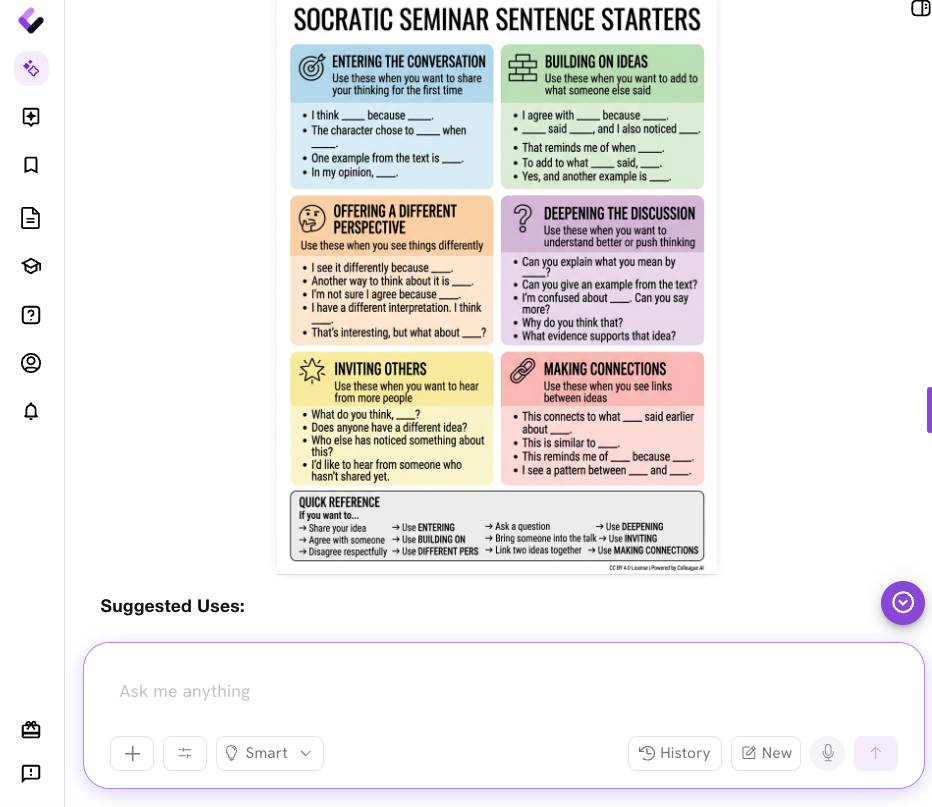
3. Create a Facilitation Guide for Yourself (Or co-teacher, assistant)
An introductory Socratic seminar requires active preparation from the teacher and disciplined restraint during the discussion.
Colleague AI can create a facilitation guide with suggested timing, teacher moves, and decision points.
Sample 45-minute facilitation guide
Minutes 0–5: Introduce the purpose
Explain that the goal is to develop ideas together through evidence, questions, and careful listening. Review the discussion norms and clarify that strong participation can include asking a question, inviting a peer in, citing evidence, or connecting two ideas.
Minutes 5–10: Model a discussion move
Show students one weak response and one stronger response.
Weak response:
I agree.
Stronger response:
I agree with Maya’s point that the character felt trapped. The description in paragraph 12 shows that he believed every available choice would hurt someone.
Ask students what the second response contributes to the group.
Minutes 10–13: Prepare individually
Give students three quiet minutes to:
-
Star one passage they may cite
-
Choose one sentence starter
-
Write one question they could ask
-
Identify one idea they’re still considering
Minutes 13–35: Conduct the seminar
Open with the central question. Track participation without interrupting the flow of the discussion.
Use a teacher prompt only when the group needs support:
-
What evidence could help us examine that idea?
-
Who can connect these two interpretations?
-
Which assumption are we making?
-
What question has the group avoided?
-
Whose perspective could help us see this differently?
Minutes 35–40: Close the discussion
Ask each student to write one idea that changed, grew, or became more complicated during the seminar.
Invite two or three students to share.
Minutes 40–45: Complete the self-assessment
Students rate their participation and identify one goal for the next seminar.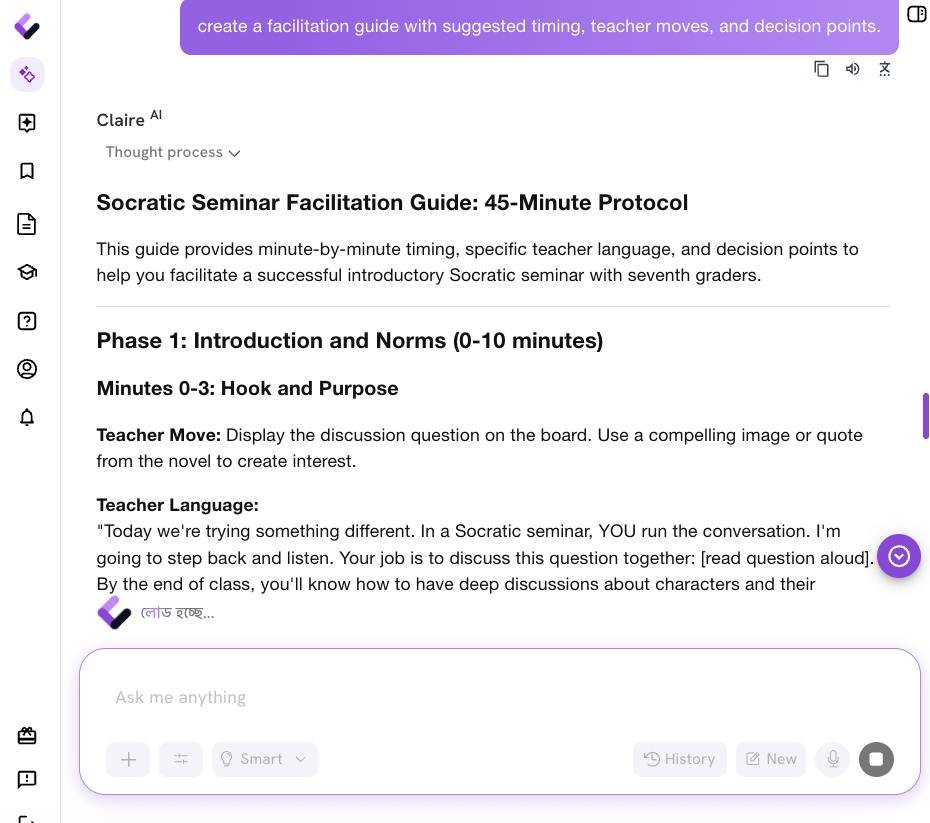
This guide gives the teacher enough structure to protect the conditions for discussion while leaving the intellectual work with students.
4. Generate a Self-Assessment Rubric
A first seminar works best when students are assessed on learnable discussion behaviors. A student who speaks six times hasn’t automatically contributed more than a student who asks one question that changes the direction of the conversation.
Create a brief rubric students complete immediately after the seminar.
Sample student self-assessment
Rate yourself from 1 to 4 for each statement.
| Seminar behavior | 1 | 2 | 3 | 4 |
|---|---|---|---|---|
| I came prepared with notes, evidence, or questions. | Rarely | Sometimes | Usually | Consistently |
| I listened and responded to other students’ ideas. | Rarely | Sometimes | Usually | Consistently |
| I used evidence or specific examples to explain my thinking. | Rarely | Sometimes | Usually | Consistently |
| I helped make space for other people to contribute. | Rarely | Sometimes | Usually | Consistently |
| I asked questions or added ideas that helped the group think more deeply. | Rarely | Sometimes | Usually | Consistently |
Reflection questions
-
What did you contribute to the group’s thinking?
-
Which idea from another student affected your thinking?
-
What will you try during the next seminar?
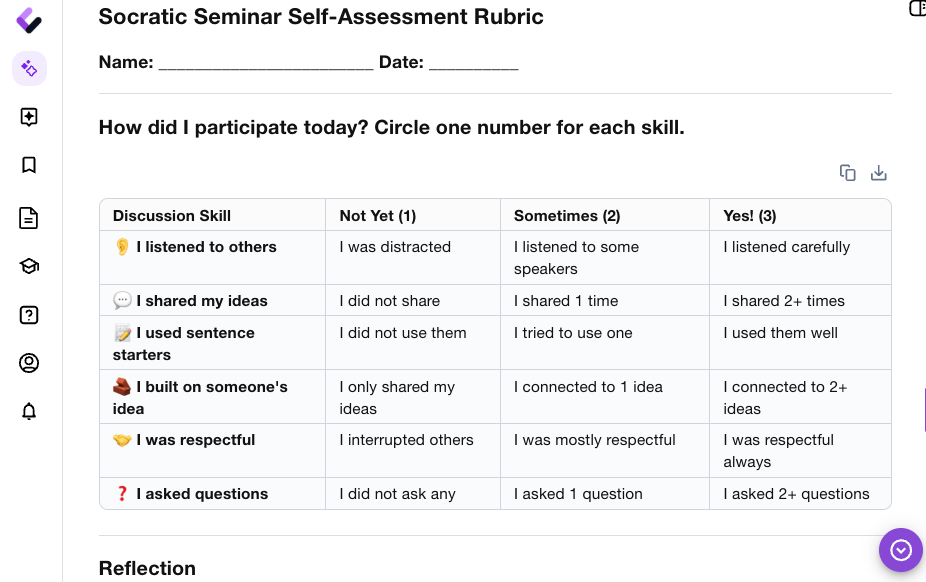
The completed reflection can serve as a formative data point. Before the next seminar, the teacher can review patterns, reteach one discussion skill, and adjust supports for individual students or the full class.
Adjust the Materials Before You Teach
Colleague AI provides a strong first draft. The teacher still knows the students, the text, and the purpose of the lesson.
Review the materials and make a few deliberate choices:
-
Reduce the number of sentence starters when the full list may feel overwhelming.
-
Add text-specific vocabulary students will need during the discussion.
-
Choose the central question yourself or revise the generated question to match the intellectual work of the unit.
-
Decide how students will participate, including a single circle, fishbowl, partner rehearsal, written backchannel, or smaller seminar groups.
-
Adjust the rubric language to reflect the discussion skills you’ve already taught.
-
Plan access supports, including translated directions, visual cues, additional processing time, or the option to submit a written contribution.
Give Students a Rehearsal Before the Circle
Students’ first experience with a Socratic seminar shouldn’t begin the moment they move their desks.
Use five minutes during the previous lesson to rehearse one discussion move. Students can practice building on a partner’s idea, disagreeing with evidence, or inviting another person into the conversation.
That small rehearsal creates shared expectations. It also gives students a chance to use the sentence starters before they’re managing a full-group discussion.
By the time the seminar begins, students know:
-
What they’re discussing
-
What successful participation looks like
-
What language they can use
-
How the teacher will support the process
-
How they’ll reflect afterward
The circle of desks is the least complicated part.
Colleague AI helps teachers build the conditions around the discussion so students can focus on listening, reasoning, and developing ideas together. The first seminar may still include long pauses, overlapping voices, and a student who forgets the question halfway through an answer, but students are learning a discussion practice, and the teacher now has a protocol they can refine and use again.