By Dr. Min Sun, Co-founder & CEO, Colleague AI · Monday, September 7, 2026
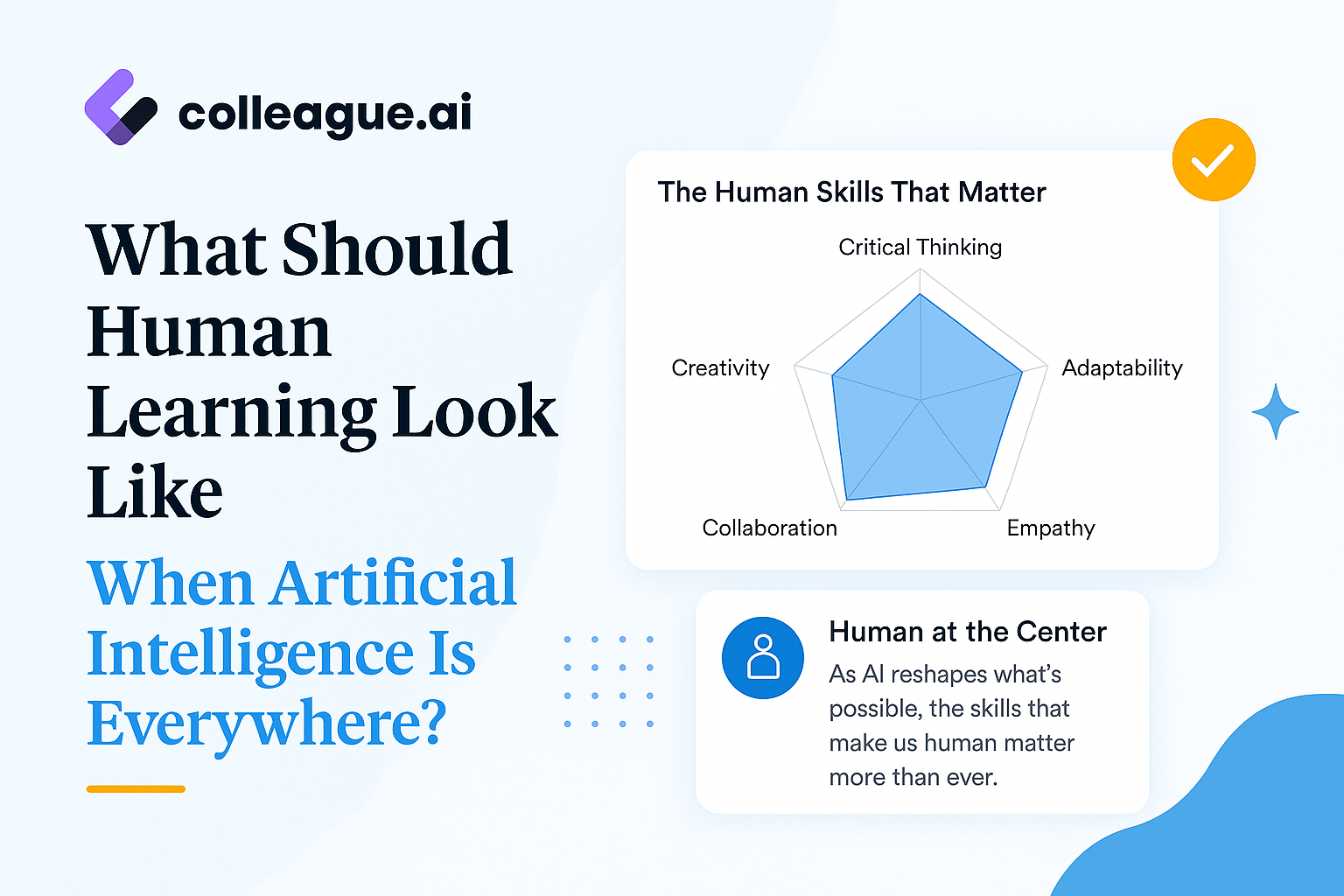
As I think about the defining question in the AI era—what should human learning look like when artificial intelligence (AI) is everywhere— I'm wearing several hats: a researcher, an educator, a parent, and a technologist. From each vantage point, I see the same tension: AI can extend educators's instructional capacity, and make personalized learning we long desired become eventually available to all students at scale, but if used inappropriately, we can accidentally outsource our professional judgment and remove the intellectual effort through which students learn. So, the central challenge is not simply whether to allow a new technology in school; instead, the question should be about how to use AI without outsourcing human intelligence, and even more fundamentally, how to define meaningful human learning when AI is becoming part of nearly every aspect of life.
Recent headlines show how schools are wrestling with that tension. New York City Public Schools has announced a one-year moratorium on student-facing generative AI from prekindergarten through eighth grade. Districts such as Los Angeles Unified School District are limiting screen use among younger students. These policies reflect real concerns about child development, academic integrity, privacy, and the place of technology in learning. They are not, however, universal bans. New York City teachers may still use approved AI tools for planning and administrative work, and high schools will offer limited, supervised use with AI literacy instruction.
At the same time, other school systems are moving carefully toward AI adoption. We are working with hundreds of schools nationwide, including school districts with complex systems, as they develop systemwide approaches to responsible AI use. Their questions are practical:
- How should educators model good AI use for students?
- Which AI applications deepen learning rather than simply speed up task completion?
- How can schools prepare young people for college, careers, and a workforce in which AI will be common?
- What system conditions—such as teacher learning opportunities, policy guidelines/FAQs, and regular data monitoring to refine practices— should be in place to support system-level implementation?
The national landscape is not divided neatly between adoption and rejection. Schools are making different judgments about when, where, and how AI belongs.
Traveling to schools and communities across the country has made these questions more concrete for me. I have spent time in communities in Pennsylvania, Texas, Florida, Kentucky, Minnesota, Indiana, California, New Jersey, Washington, Oregon, and Idaho, where I personally led professional-learning sessions (each lasted 60-90 minutes) to ~1,200 educators, school leaders, and community members in K-12.
It was clear from these visits, sessions, and discussions that, in communities facing poverty and in districts whose learners have diverse needs in academic mastery, languages, and disabilities, AI may help educators provide personalized support that would otherwise be hard to offer at scale. A rural teacher without a subject-area colleague may gain a useful thought partner in AI for planning and problem-solving. An inner city student with limited access to specialized courses or individual academic support may benefit from a thoughtfully designed AI 1:1 teaching aide, created by their teachers. These possibilities matter because access to expertise, strong instructional materials, and enrichment remains deeply unequal across schools nationwide.
These first-hand experiences have sharpened the questions I believe matter most:
- Under what conditions, for which purposes, and for which aspects of human learning can AI contribute?
- How do we upskill educators' competency in order to evaluate and use AI tools well, and be able to model responsible AI use practice?
- How do we transform our classroom instructional practices so that students can experience learning opportunities that truly allow them to develop these AI-ready skills?
- And more fundamentally, how do we define human intelligence and K-12 student success in the AI era?
During the Labor Day weekend, I took the opportunity to write a commentary that I hope is useful to direct the field's discussions on AI in K-12 to be grounded in both research and practice. Answering the question of what human learning should look like in the AI era is just too important to be motivated by political advocates and skeptics alike. It requires us to learn openly from teachers, students, technologies, and researchers who are actively experimenting and exploring to help us build a stronger scientific foundation so that schools can make decisions based upon rigorous evidence.
I will first summarize survey data from a nationally representative sample of mathematics and science teachers about their AI use, describe an early research on Educator Preparation Program (EPP) faculty's experiments on integrating AI in their teacher training programs, and highlight the still-limited evidence on AI effects on student outcomes. Toward the end, I leave you with three thoughtful practitioners' experiments in their own classroom and schools, and their learning about screen time, academic integrity, and student learning. If their practices inspire you, I invite you to join me in five actions introduced at the end.
Teachers Are Adopting AI Fast
Generative AI has moved rapidly from an emerging technology to a substantive presence in K–12 educators' work. The AmplifyLearn Center at the University of Washington (UW AmplifyLearn Center), in partnership with RAND's American Teacher Panel, collected two years of surveys among nationally representative math and science teachers (full report here). In 2026, 58%of teachers reported using generative AI for instructional tasks, up from about 50%in 2025. The change was more pronounced among frequent users: 31% reported using AI daily or weekly for instructional tasks, compared with 21% the previous year—a 10-percentage-point increase. Among the teachers already using these tools, 65% said their use had become more frequent over the school year, while only 3% reported using them less frequently.
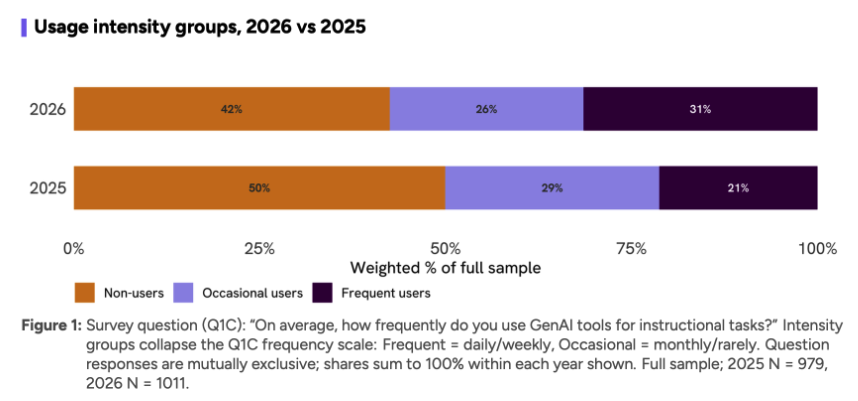
Note. Cited from the report, titled “adopted but unstructured”. See full report here.
The more revealing data points are around what teachers do with AI. Among users, 76% used it for instructional planning, 58% for creating assignments or assessments, and 57% for adapting activities to different achievement levels or learning needs. Teachers said AI helped them improve materials, formulate questions, connect concepts, and create visual representations. They were far less likely to use it for grading or to teach students how to use AI. In other words, teachers are mainly using AI as a resource for preparation and content development rather than replacing their human interactions with students in instructional delivery, such as grading and providing student feedback or letting AI directly teach students.
The surveys also challenge a familiar promise from many tech vendors to schools: AI will save your teachers' time or make your teachers work less. For example, teachers in the survey reported working about 45 hours per week, with no statistically significant difference among non-users, occasional users, or frequent users in total hours. Frequent AI users actually reported spending 7.3 hours per week planning lessons—1.4 hours more than non-users. We cannot tell from this survey why. Perhaps teachers who plan more are more likely to adopt AI. Perhaps AI helps them do more ambitious work in the same amount of time. The safer conclusion is that AI may be changing the scope and quality of teachers' work, not merely shortening it.
Teachers See Both the Promise and the Risk of AI
Educators from the UW AmplifyLearn's national surveys see potential benefits. They rated AI's effect most positively for conceptual understanding and research skills. Teachers have also described potential value for multilingual learners, students with disabilities, and students working above or below grade level—especially when AI helps educators adapt explanations, examples, activities, and representations. Yet teachers' overall judgments remained divided: 29% rated AI's effect on student learning positively, 32% negatively, and 39% neither positively nor negatively.
Greater adoption has accompanied greater teacher concerns. More than 60% worried about AI replacing human creativity, students becoming overly reliant on it, unreliable content, and ethical use. Sixty% saw a negative effect on academic integrity. Concern increased alongside adoption across every issue we measured. I do not read that as a simple backlash. Teachers may be learning enough through experience to see both what these systems can do and where they fail. They are adopting AI and becoming more critical of it at the same time.
To highlight one significant observation which policymakers and system leaders can definitely take actions upon: The institutional support—including but not limited to training and guidelines—around teachers has not kept pace. The leading obstacle to AI use in instruction was the time needed to learn and experiment, reported by 61% of survey respondents. Related to this, the second top obstacle is lack of AI training and professional learning opportunities. Other barriers included difficulty integrating AI with existing curricula and unclear district policies on AI use. Teachers' requests for training were practical: learn how to use AI for lesson planning and differentiated learning materials, tool fundamentals, student supervision and guidance, technology integration, and assessment and feedback.
How Teachers' AI Use in Instruction Can Be Developed? Training Must Build Judgment, Not Just Tool Fluency
UW's AmplifyLearn Center, in partnership with the Institute of Education Sciences (IES) under the U.S. Department of Education, conducted a higher education Educator Preparation Program (EPP) Faculty Collaboratory over the 2025-26 school year (full report here). This EPP Collaboratory offers a useful lens for how to develop teachers' AI competency. The six-month effort involved 15 faculty members from 13 higher-education institutions, with 12 faculty completing the full design-and-implementation cycle. Participants represented mathematics education, assessment, multilingual education, educational technology, elementary education, and clinical practice across R1 research universities, regional colleges and state universities, and an HBCU.
One conclusion came through clearly: integrating AI is an instructional-design problem, not merely a tool-adoption problem. The faculty members collectively learned that AI was most productive in training ‘student teachers’ —who learn to become teachers— when it supported professional judgment rather than bypassing it. Student teachers used AI as a thinking partner, critique generator, rehearsal tool, or planning scaffold while remaining responsible for evaluating, adapting, rejecting, and defending its recommendations. As faculty members agreed: a polished AI-assisted lesson plan was not evidence of professional competence unless the student teacher could explain why it fits their students' needs, their state learning standards, and their own instructional goals.
Sequencing of learning activities with and without AI mattered. In several courses, student teachers first completed essential disciplinary analysis independently and only then used AI to generate alternatives or refine their work. This protected the noticing, analysis, planning, and reflection the course was designed to develop. When AI entered too early, it could produce a credible artifact while bypassing the reasoning behind it.
Critical evaluation did not arise automatically. Stronger activities required student teachers to preserve prompt histories, compare outputs, identify hallucinations or bias, annotate revisions, explain what they accepted or rejected, and sometimes defend their decisions orally. The most useful professional-learning cycle can therefore be summarized as generate, inspect, critique, revise, and justify. The goal is not simply an educator who can prompt effectively. It is an educator who knows when AI is useful, when it is unreliable, and when it should not be used.
Instructional tasks also shaped responsible use of AI. Appropriate AI use boundaries differed across pedagogical methods, multilingual education, assessment, clinical practice, and AI-literacy courses. A single rule for every course or task was inadequate. Programs need shared principles concerning privacy, authorship, disclosure, equity, and human agency, with flexibility for educators to apply those principles to particular learning goals and students.
Effective practice of training teachers' AI competency needs iteration and experimentation itself. Nearly every faculty member revised their course and activity design throughout this process. Student teachers needed more scaffolding than expected; platform navigation sometimes competed with pedagogical learning; and familiarity with consumer AI did not automatically translate into professional competence.
Overall, one of the conclusions of the EPP Faculty Collaboratory was that one-time workshops centered on prompting are vastly inadequate to be considered “AI training for educators”. Responsible training implementation requires structured time, scaffolded and sequenced activities connected to authentic curriculum and best practice of teaching, and repeated practice. A sensible starting point is one scoped instructional task, one clear purpose, and one learning cycle of evidence and reflection before scaling.
Clear Guidelines Provide Bounded Experimentation on Responsible AI Use
We do not yet know whether having a district AI policy causes teachers to use AI more frequently. The UW national survey shows an association: 54% of non-users reported having no district guidelines, compared with 32% of frequent users. Established formal policies were reported by 18% of frequent users but only 6% of non-users. However, teachers were not randomly assigned to policy environments, thus, we cannot conclude that district guidelines cause more frequent use. There is a possibility that districts with more frequent AI-use teachers may be more likely to develop guidelines, and policy and AI adoption may reinforce one another.
As researchers, what we can conclude is that clear guidance gives teachers a safer and more predictable environment in which to experiment. Guidance can identify approved tools, protect student information, distinguish appropriate uses by age and purpose, and spell out where professional judgment remains essential. Without guidance, teachers may avoid useful applications—or experiment on their own without consistent safeguards, both of which may not be the most desirable outcome for schools or for students.
Among teachers who reported having district guidance in the Survey, 87% described policies that permitted AI under some form of restriction. Only 1% reported complete prohibition. The dominant direction is therefore neither unrestricted adoption nor universal prohibition of AI usage in K-12, but conditional and differentiated use.
For this reason, AmplifyLearnhas developed adaptable guidelines that schools and districts can download and revise for their instructional goals, student populations, infrastructure, and community expectations.
- District AI Use Guideline Template
- Parent AI Guideline
- Student AI Use Toolkit
- Conversation with Teacher Union Toolkit
AI Use is Not Just about Individual Educators' Adoption and AI Adoption in Schools Has a System Perspective
Most conversations on “AI in education” currently focus on educators' usage and adoption of AI, or adoption of AI tutoring tools for students. However, this is only one aspect of operating organizations responsible for educating our nation's youth. Zoom out to a school-level or district-level perspective, and we start asking questions and looking at conglomerate data to address systemic issues or challenges, such as curriculum alignment, instructional best practice implementation, and other management-level items.
One school leader shared a story with me. The school had recently adopted an AI system that systematically analyzes their data in a timely fashion and makes the relationship between a school's strategic vision and teachers' daily practice more visible. Through an aggregated school-level report of anonymized teacher activity, she could examine broad patterns in how educators used AI without reviewing individual conversations, thus revealing whether the school's planned curriculum and instructional mission were appearing in teachers' instructional materials, assessment, and classroom activities.
Faculty at the school found it affirming to see evidence from their collective practice that AI was helping their desired instructional approach take hold in the classroom. Rather than relying only on plans, meeting notes, or periodic observations, the school could identify traces of its strategic initiatives in teachers' everyday work. She continued on:
it [her sharing the data to her faculty] strengthened transparency and reinforced the collective pride of our staff that their hard work paid off: the data match their daily experience.
This kind of insight has never been available before. We have a new source of data for school leaders and district administrators to understand what's actually happening in classrooms with regards to curriculum and instruction that doesn't rely on observation sessions.
Further, AI tools, applications, and use for school administrators and district leaders does not at all stop with curriculum and instruction! I've conducted many training sessions on topics ranging from designing data instruments to collect stakeholders' voices, establishing data-informed school improvement systems (Plan-do-study-act cycles), to enrollment forecasting and budget allocations. Leveraging AI data analytic functions, school communities now have tools to examine, validate, and refine their collective practice on a regular basis without costing schools tens of thousands to hire an external research consultant.
AI Usage Efficacy on Student Learning and Teachers' Instructional Quality: What the Current Evidence Can and Cannot Tell Us
The efficacy of AI discussion requires a sharp distinction among three questions:
- Does AI help someone perform a task using the tool?
- Does AI-supported activity produce student learning that presents enduring knowledge and skills in the AI era?
- What technology features and how were they used by teachers and students to generate the measured student learning gains?
These questions are often opaque or collapsed in public debate, but academically there are different answers to them.
For example, the Stanford SCALE Initiative's 2026 review examined more than 800 papers about AI in K–12 education in its repository as of October 2025. Only 20 met its standard for high-quality causal research. Most papers focused on students rather than educators, and mathematics was the most extensively studied subject. To highlight here, the review found little high-quality causal studies of student AI use conducted in the U.S. K–12 classrooms. Instead, the study locations include England/United Kingdom, Germany, Turkey, Belgium and Spain, Brazil, South Korea, Netherlands, and unspecified countries, including many postsecondary students. Therefore, the implications in the U.S. K-12 is limited. Moreover, research on long-term learning, equity, student well-being, and social development also remains scarce.
Across the limited causal literature, students frequently performed better on mathematics practice, programming, or writing tasks while AI was available. Results were mixed when students later completed assessments without AI: in some studies learning persisted; in others, performance was unchanged or declined. Improved AI-assisted performance is therefore not necessarily evidence of durable learning.
AI tool design appears consequential. Tutoring systems that provide hints, ask questions, scaffold reasoning, and gradually release responsibility show more promising results than general-purpose chatbots that simply supply answers. Effective tools preserve productive struggle—providing enough support to move students forward without removing the cognitive work through which understanding develops. What do we conclude from this? That the evidence cautions against treating every AI tool, or every use of the same tool, as educationally equivalent.
The Stanford review also identifies early promise for educator-facing AI tools or systems. The small group of causal studies suggests that AI can offer teachers real-time suggestions that encourage guiding questions, and provide insight into classroom interactions or student progress. Yet the number of studies is small, technologies are changing quickly, and broad conclusions remain premature. Thus, again, more research and studies are required and we can't draw that many conclusions today.
More Preliminary Data on K-12 U.S. Systemwide Adoption: Encouraging Signal on Reading Outcomes, But Not Yet Causal
It is clear from the field that we need more rigorous evidence on the impact of AI use in the U.S. K-12 settings. As part of their product development cycle, UW AmplifyLearn Center and Colleague AI in partnership conducted a midyear study of Colleague AI's implementation across 12 rural, suburban, and urban school districts from September through December 2025. Unlike many prior studies summarized in SCALE's study, which are often in small-scale, controlled experimental settings, the mid-year report examined technology adoption in a regular, systemwide adoption contexts. Within the 12 school districts in the report, the teacher adoption of the Colleague AI platform increased from 1,438 teachers in September, 2025, to 2,891 by the end of December—nearly 30% of teachers in the participating districts—and reached 4,644 by March 31, 2026. During the initial four months, teachers exchanged more than 412,000 messages. Active users averaged 12 sessions and approximately 3.7 hours on the platform. This represents a decent, but not unusually high treatment intensity, yet very much resembles the early stage adoption pattern of a technology in a regular school system.
Lesson planning dominated use, accounting for 60-99% of activity in every participating district. Given our previous discussion on teachers using AI for planning and content development tasks, this is expected. Teachers serving greater shares of multilingual learners or students receiving special-education services were more likely to discuss student profiles, differentiation, and accessibility. Teachers in classrooms with lower average test scores or greater achievement variation showed similar differentiation-oriented patterns. Such usage patterns indicate that AI truly does have potential to positively impact learners who need additional support or benefit from ongoing differentiation of learning materials.
The report also offers one preliminary connection to student outcomes. Its analysis included 12,005 students in grades 3-8 with matched beginning- and middle-of-year interim assessments from two districts. After accounting for prior scores, assessment type, district, English-learner status, disability status, and attendance, approximately 3 hours of teacher AI use was associated with a 0.025-standard-deviation increase in reading scores. The corresponding relationship in mathematics was not statistically distinguishable from zero.
This is an encouraging signal, but it is not proof that AI has causal impacts - meaning we're not 100% sure that AI is the reason for which an outcome such as improved reading scores occurs. We cannot surely conclude that AI has no impact on students' mathematical learning either. In this study, teacher adoption of AI tools was voluntary. Although the authors used statistical control to make the higher-usage group look similar to the lower-usage group, higher-usage teachers may still differ in motivation, planning habits, instructional expertise, or other unmeasured characteristics. So again, more research and study is needed before we can actually tie the usage and impact of AI to specific learning outcomes for students or outcomes for teachers.
Taken together, the studies support evidence-informed experimentation. We have credible evidence that educators are adopting AI; descriptive evidence that they use it for serious instructional purposes; early causal evidence that carefully scaffolded tools can improve some outcomes; and a preliminary positive association between teacher use and reading performance.
More importantly, we do not yet have enough evidence to conclude AI effects on student learning outcomes, because we haven't yet defined what students' success looks like. Is traditional standardized test scores the correct benchmark? May not entirely. Once we define student success, then we can explore how to effectively develop AI technology and implement it in ways to cultivate such success. Moreover, it takes time for a complex educational system to generate return on investment (ROI), at least 6 months to one year of instructional time. But this should not stop us experimenting.
Now Is the Time to Increase Bounded Experimentation in AI Use in K-12 Education
Fortunately, there are thousands and thousands of educators nationwide who have the will and capacity to continue experimenting, studying, and innovating, in addition to many, many education researchers who are having a field day studying AI in K-12.
AI is unlikely to disappear from students' lives or teachers' work. We must continue to accumulate evidence about how AI affects classroom practice, instructional transformation, and student learning. At the same time, the complexity of this work should not become a reason to stop experimenting. Student learning is itself a dynamic target. As AI transforms the economy, civic life, and everyday experience, schools will need to reconsider what student success should mean in a K–12 setting—including the knowledge, judgment, creativity, agency, and capacity to work responsibly with emerging technologies that young people will live with.
I want to leave you with brief perspectives from three school leaders. They share many of the doubts and unresolved questions explored in this essay, but they are also experimenting with AI in their classrooms and schools. They speak candidly about the relationship between teachers and students given AI's presence, academic integrity, and student learning. Their experiences are not a prescription. I hope they offer something more useful: an invitation to approach this work with curiosity, care, and the courage to learn in public. Simply put: The exploration of how human learning thrives in the AI era is just too important to put it on a pause.
Dr. Michelle Zimmerman is an educator and author. She holds a PhD in Learning Sciences and Human Development from the University of Washington and serves as Executive Director of Renton Prep, a Microsoft Showcase School. Michelle is the author of Teaching AI: Exploring New Frontiers for Learning.
Lauri Nichols brings over 20 years of experience in transformative education at Renton Prep, specializing in project-based l learning. She holds a Master's degree in Educational Technology and Design and helps educators integrate innovative technologies into meaningful learning design.
Jonathan Briggs is Chief Technology and Innovation Officer at Eastside Prep. He started his career as a physics and math teacher before joining Eastside Prep as its founding Director of Technology. Over two decades he's guided the school through wave after wave of technological change, and is a sought-after advisor to schools and companies working through the same questions.
Podcast Snippet: Using AI to Develop Intelligence
Postcast Snippet: Trust Among Students and Teachers in an AI World
Podcast Snippet: Rapidly Changing Technology VS Constant Learning Principles
If Their Practice Inspires You, Five Ways You Can Join the Work Too!
Our nation's students cannot wait for the research base to become more complete before schools begin responding, implementing, or using AI in K-12 education. AI is advancing too quickly, its adoption is already too prevalent, and it is already influencing how people find information, produce knowledge, communicate, and work. The question is no longer whether AI belongs to schools in the abstract; rather, it is about which technology designs work, for which learners and educators, under which conditions, and for what purposes. To answer those questions, UW AmplifyLearn and Colleague AI invite you to join the following five initiatives:
Initiative #1: Free Professional Learning Partnerships to Build Educator's Competency
UW AmplifyLearn and Colleague AI are expanding access to free professional learning on AI for educators. With support from IES and NSF, we are partnering with higher-education institutions, education service agencies, local education agencies, county offices of education, and non-profit learning networks to offer free AI-focused training to schools and districts across the country. The training program includes synchronous and asynchronous options, professional learning customized to local needs, and participation in a national learning network where educators can share implementation lessons and resources.
Schools and districts interested in participating are invited to indicate their interest through the form below. Capacity is limited, so early responses will help us plan partnerships and allocate support.
Professional learning interest form link.
Initiative #2: National Research and Development (R&D) Agenda
Drawing on our research and our synthesis of the broader evidence base, we are developing a national R&D agenda for human learning in the AI era. The agenda will identify essential questions about teaching, learning, assessment, equity, human judgment, creativity, and the design of responsible AI systems. We invite researchers, educators, and technologists to use this agenda as a shared foundation—and to challenge, refine, and extend it as new evidence emerges.
Initiative #3: National Seed Grant Competition
With support from IES, UW AmplifyLearn Center plans to offer small seed grants to researchers and technologists across the country in the Fall 2026. These awards will support early-stage work on questions identified in the national research and development agenda, as well as promising questions proposed by participating researchers themselves. The goal is to enable rapid exploration, strengthen cross-sector partnerships, and help promising ideas develop into rigorous programs of research and design on various topics of AI use in education, with some of them identified in the R&D agenda linked above.
Future Seed Grant information and application will be provided here
Initiative #4: Collaborative AI Product and Tool Development
School systems should help shape the tools they are being asked to use. Through work supported by the National Science Foundation Small Business Innovation Research (NSF SBIR) Phase II program, Colleague AI is inviting districts to co-design and test product features with our team. Participating districts will receive support for the collaborative design process while helping Colleague AI examine questions such as how AI can better support special education, cultivate student creativity and reasoning, and build graduate portraits that reflect future workforce skills/knowledge. Districts interested in becoming co-design partners are invited to indicate their interest through the form below.
Colleague AI co-design interest form link
Initiative #5: Rigorous Independent Efficacy Studies
With support from IES, NSF, and potentially other private foundation support, Colleague AI team will partner with external evaluators to study Colleague AI's effects on student learning and teachers' instructional quality. The research will examine variation across learners and settings, and report limitations as carefully as positive findings.
We will release study findings in a timely manner as they become available so that educators, system leaders, researchers, and technology developers can use the evidence to guide future decisions. We invite the field to follow this work, scrutinize the results, and build on what the studies reveal.
In sum, I urge the field to treat districts' AI guidelines not as a pause on continuous refinement of human learning processes, but rather as bounded permission for educators to experiment with new practices, validated through data, to better serve students for whom the entire education system exists.
Now let's come to the question that I posed at the beginning of the essay: what should human learning look like when AI is everywhere? I do not yet know the precise answer to it. The technology is advancing too quickly, the evidence base remains limited, and our definitions of student success are still evolving as a result. But uncertainty is not a reason to pause experimentation; instead, it should be the reason to investigate more carefully. Educators, researchers, students, families, and technology designers must continue experimenting together. Therefore, What I can safely say today is that:
We have a shared responsibility. The development of human intelligence may be one of the defining challenges of our survival. The future of learning should be designed by humans who choose to think, create, and live together—not determined by the advance of AI.
By Min Sun, Ph.D.
Co-Founder and CEO of Colleague AI
Professor at the University of Washington College of Education
Sources
- Liu et al. 2026 Adopted but Unstructured
- AmplifyGAIN Center 2026 AI Integration as Instructional Design
- Esbenshade et al. 2026 Generative AI in K 12 Classrooms Midyear Implementation Report
- Stanford SCALE Initiative 2026 Understanding the Evidence Base on AI in K 12 Education
- New York City Public Schools 2026 Guidance on Artificial Intelligence and Screen Time