By Week 5, one student keeps pulling your attention.
They’re in class most days, aren’t causing major disruptions, and their grades haven’t fallen far enough to trigger an automatic referral, but still, something is off.
They put their head down during independent work. They ask to use the bathroom when writing begins. They complete assignments when an adult sits beside them, then turn in almost nothing the next day. During a private check-in, they say they’re fine.
You’ve shortened tasks, moved their seat, repeated directions, offered breaks, and checked in more times than you can count. You’re starting to wonder whether the problem is skill, confidence, attention, stress, attendance, or several things at once.
This is the Week 5 MTSS problem: the student needs support now, and the evidence is still scattered across your gradebook, observation notes, unfinished assignments, and memory.
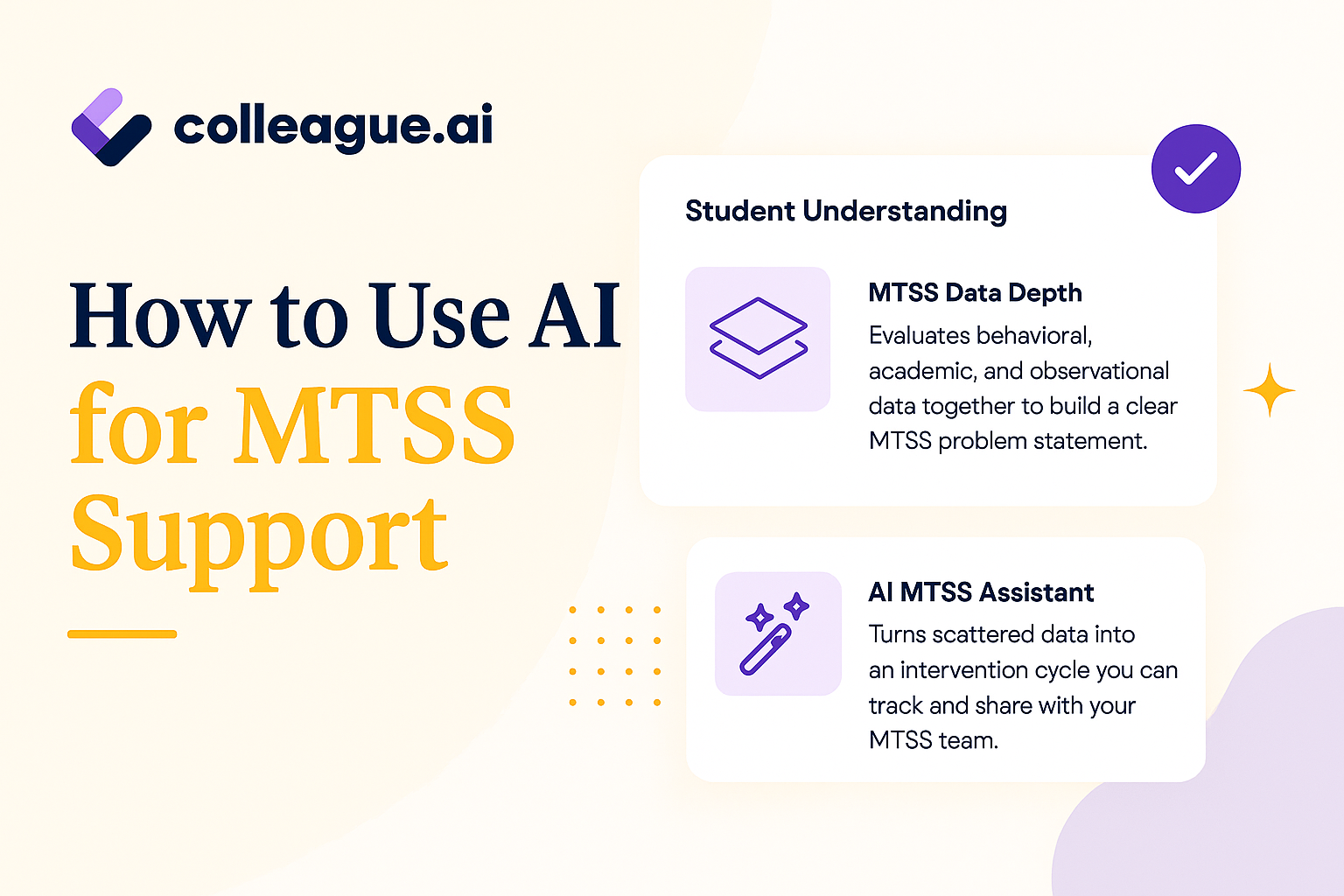
Colleague AI helps teachers turn that scattered evidence into an intervention cycle they can use, track, and share with the school’s MTSS team.
The Situation Teachers Actually See
Imagine a sixth-grade student named Maya.
During whole-class discussion, Maya occasionally gives strong answers. During partner work, she participates when paired with a familiar classmate. During independent work, she often:
-
Waits several minutes before beginning.
-
Asks to leave the room.
-
Writes one or two words, then stops.
-
Says, “I don’t know,” before reading the full question.
-
Completes more work when the teacher stays nearby.
-
Becomes quiet or tearful when asked about missing assignments.
Her recent scores are inconsistent:
-
8 out of 10 on a vocabulary check
-
2 out of 8 on a written response
-
0 on 2 missing assignments
-
A strong verbal explanation during a teacher conference
Maya hasn’t qualified for a formal support plan, but she still needs a clear instructional response.
Step 1: Choose “Supporting Students Below Grade” and Turn Your Concern Into an MTSS Problem Statement
Start by telling Claire, the AI Assistant, that you need to create an MTSS problem statement.
Claire will likely ask for more context, such as:
- What area of concern are you focusing on? (Academic—like reading, math, writing? Behavioral? Attendance? Social-emotional?)
- What data are you seeing that's raising the concern? (For example: benchmark scores, progress monitoring data, office referrals, grades, teacher observations, etc.)
- Which students or grade level are affected? (A specific grade? A particular group of students? Schoolwide?)
- What have you noticed or what prompted the need for this problem statement? (Are students not responding to Tier 1 instruction? Is there a gap between expected and actual performance?)
- Do you have any baseline data or percentages? (For example: "60% of 3rd graders are below benchmark in reading fluency")
Provide as much context and information you can such as:
-
The task or setting where the concern appears
-
The frequency of the behavior
-
Relevant academic data
-
Observable emotional or behavioral signals
-
Supports already attempted
-
Conditions where the student is more successful
-
Student strengths
-
Attendance or transition information that may matter
Sample Description
Maya participates during discussion and can explain ideas verbally. During independent written work, she often waits five to ten minutes before starting, asks to leave the room, or writes only a few words. She completed three of eight independent assignments during the past three weeks. She finishes more work when I sit near her or let her talk through the answer first. I have tried chunking assignments, giving sentence starters, changing her seat, offering short breaks, and checking directions privately. She sometimes becomes tearful when I ask about missing work.
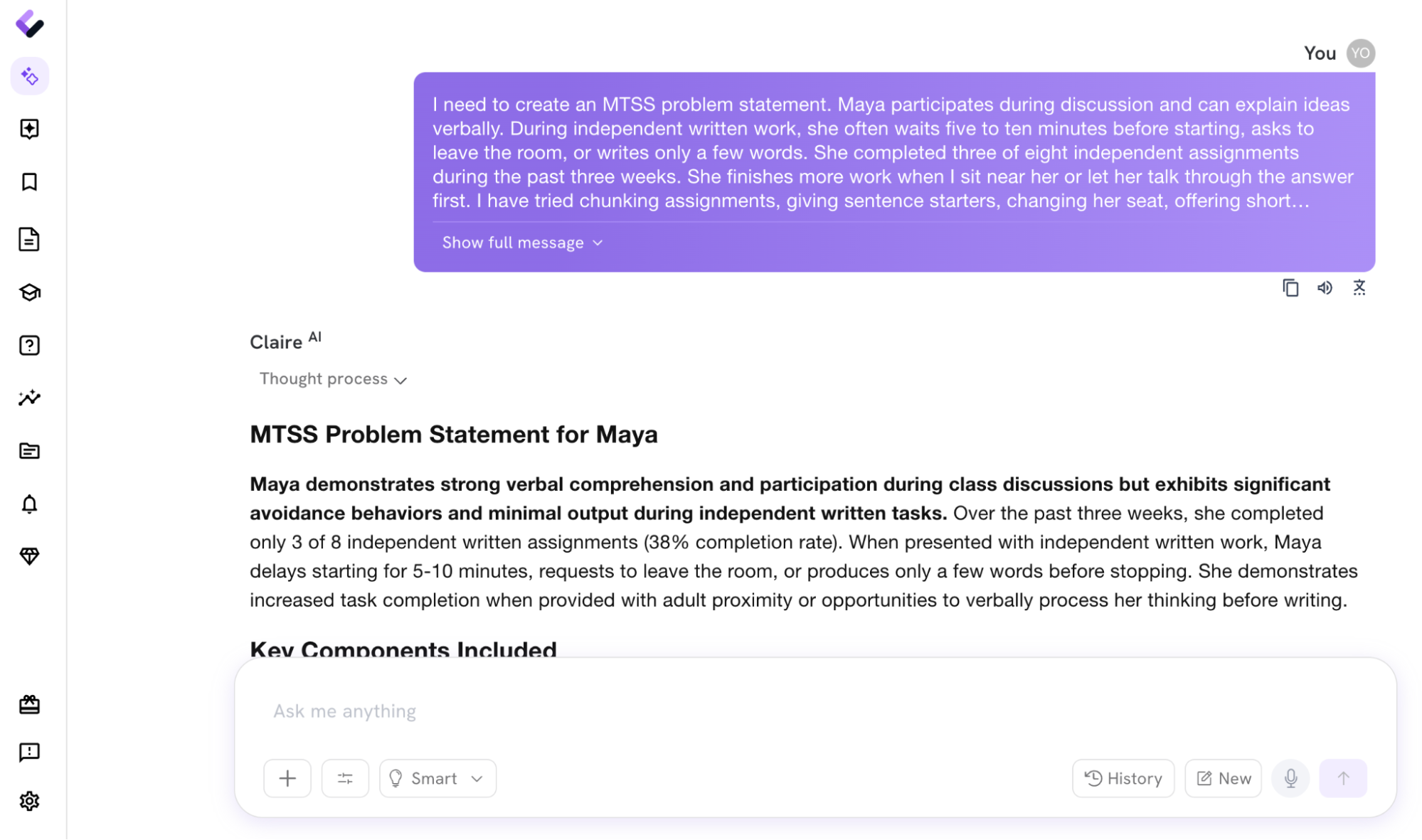
Step 2: Review the Problem Statement
Review the language, correct any inaccuracies, and add specific dates.
Now the concern is measurable.
Step 3: Separate the Skill Need From the Access Need
MTSS support becomes more useful when the teacher can identify where the task begins to break down.
Maya’s incomplete writing could come from several places:
-
She may misunderstand the text.
-
She may understand the text and struggle to organize a response.
-
She may know what to say and struggle to begin independently.
-
She may experience stress once the assignment feels large.
-
She may need support across several of these areas.
A short diagnostic assessment helps the teacher gather targeted evidence.
Step 4: Choose “Create Interactive” and Create a Brief Diagnostic Assessment
The goal is a focused check that a teacher can give during class, intervention time, or a short conference.
Tell Colleague AI what you want to achieve, the context, and a narrow instructional question:
Can Maya identify a relevant detail, explain her thinking aloud, and turn that explanation into a written response?
This question examines comprehension, oral reasoning, written expression, and task initiation.
Add context such as:
-
Grade and subject
-
Current standard or learning target
-
Type of text students are reading
-
Length of the assessment
-
Supports the student may use
-
Behaviors the teacher wants to observe
Sample Prompt
Create a 10-minute diagnostic assessment for a sixth-grade social studies student. The learning target is using evidence from an informational text to explain an idea. Include a short passage, one comprehension question, one evidence-selection task, one oral response prompt, and one written response. Add an observation checklist for task initiation, help-seeking, persistence, oral reasoning, and written response construction.
Generate the interactive, then review it.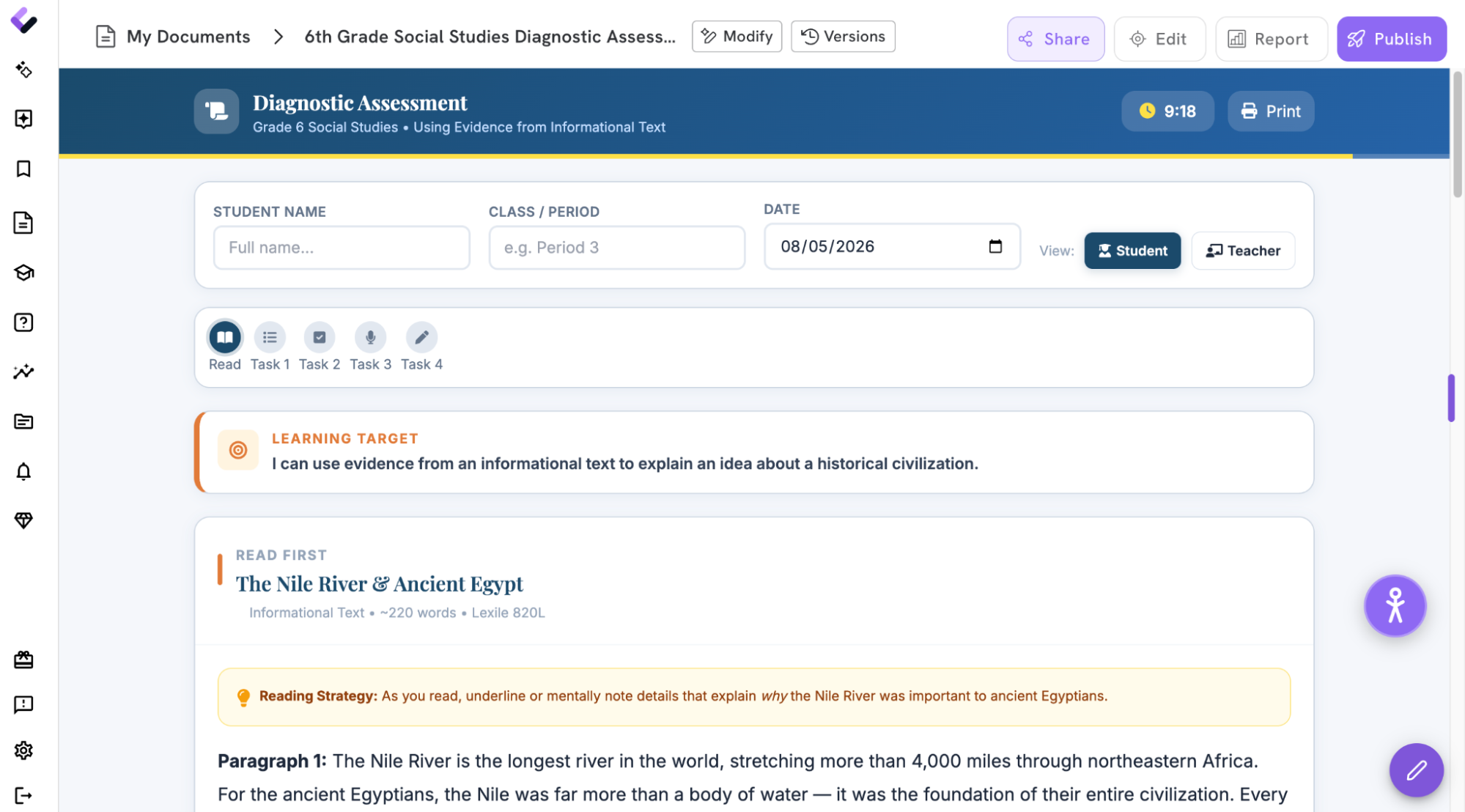
Step 5. Assign the Diagnostic and Observe the Process
When it’s time, assign the diagnostic assessment to Maya and record what she does during each part.
Example Observation Notes
-
Began multiple-choice question within 30 seconds
-
Selected the correct answer
-
Identified relevant evidence independently
-
Explained the answer clearly aloud
-
Waited four minutes before beginning the written response
-
Asked, “Does this have to be a full sentence?”
-
Completed the response after verbal rehearsal and a sentence frame
-
Appeared calmer after the task was reduced to one sentence at a time
Maya understood the content. She located relevant evidence. She explained her thinking orally.
The largest breakdown appeared during independent initiation and written response construction, especially when the task felt open-ended.
Now we have a realistic Tier 2 target.
Step 6: Build a Right-Sized Tier 2 Intervention
Colleague AI can draft an intervention plan based on the teacher’s evidence and the district’s MTSS format.
Provide the context, links to the diagnostic assessment, your MTSS problem statement, and anything else that might be useful to the AI Assistant, such as an intervention goal:
“During independent written-response tasks, Maya will begin within three minutes and complete an answer containing a claim and one supporting detail in 4 of 5 opportunities, using a visual task checklist and one verbal rehearsal.”
Specify what kind of intervention you want (or you can ask the AI assistant for a recommendation based on best practices). For example, you might want a 2-week intervention, but if your school uses block periods or different scheduling systems, 1 week or 3 weeks might be more appropriate.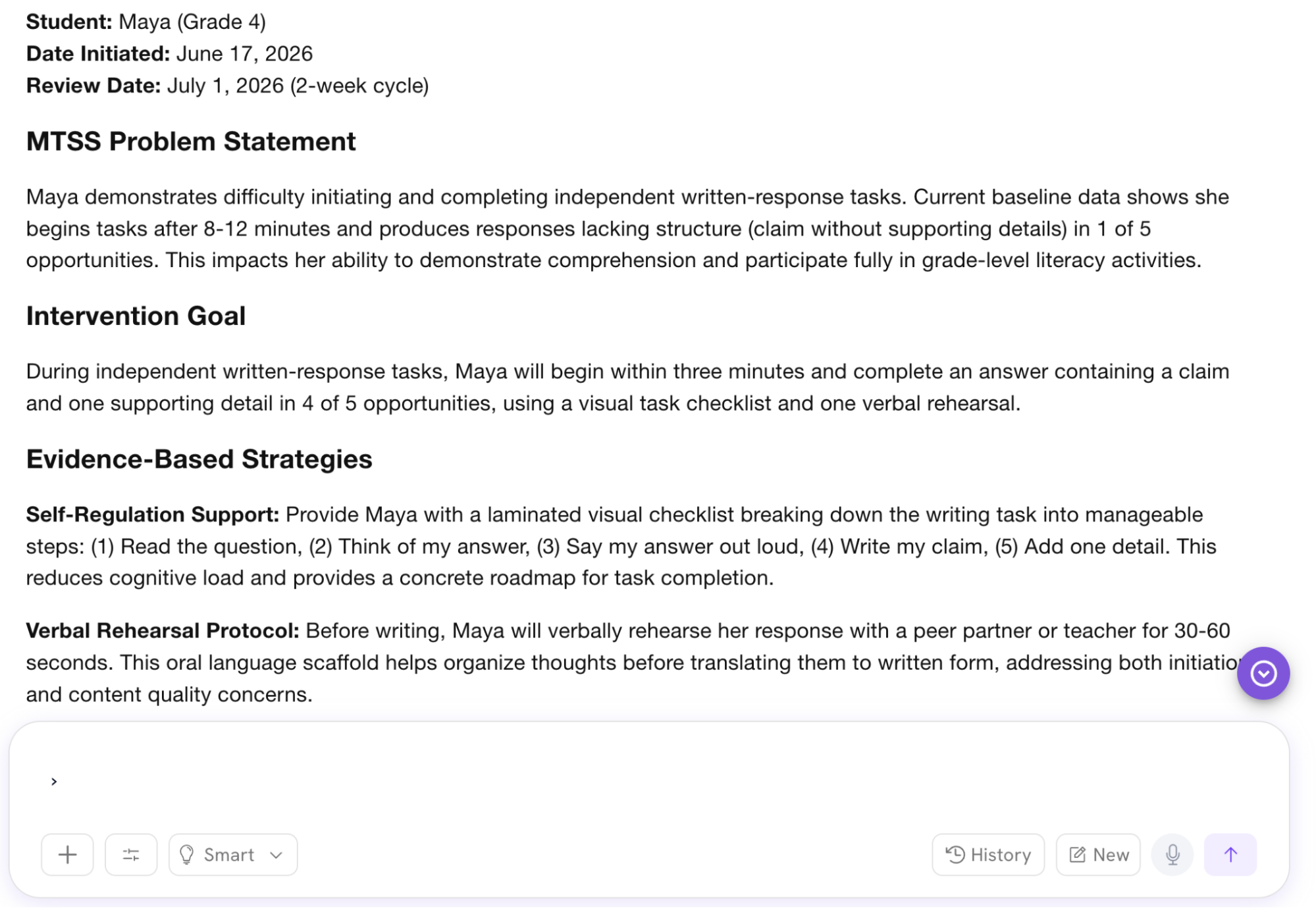
Having a Tier 2 plan helps you to then execute - you can use the plan within Colleague AI to create differentiated materials, assignments, additional activities, assessments, and more for Maya.
Step 7: Document the Intervention
MTSS documentation often falls apart because teachers are expected to record every intervention while teaching everyone else.
Colleague AI turns brief notes into clear progress language.
You can return to this document and add to it on a daily basis. For example, you may record a note:
Started after 6 min. Needed me to talk through question. Wrote first sentence after prompt. Finished 2 of 3 parts. Looked overwhelmed at first.
And Colleague AI will turn that into a professional-sounding observation note:
Maya began the independent written task after six minutes. She verbally rehearsed her response with the teacher and completed the first sentence following one verbal prompt. She completed two of three required response components. Maya initially showed signs of distress, including looking away from the task and stating that she could not complete it. Engagement increased after the task was presented one step at a time.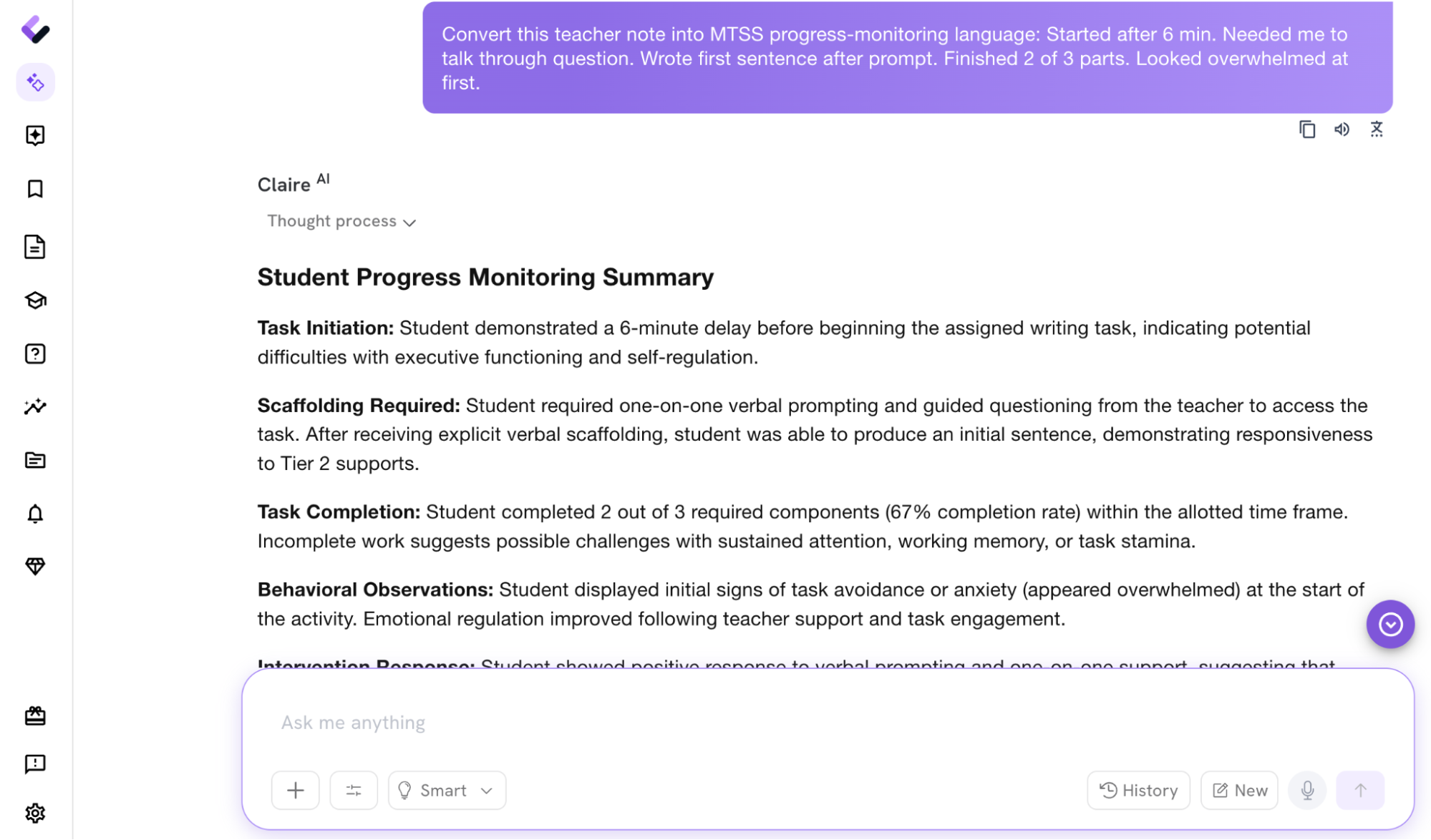
Step 8: Track Academic and SEL Signals Together
The intervention targets classroom access alongside academic performance.
A useful progress tracker might include:
| Date | Began Within 3 Minutes | Response Completed | Support Used | Student Signal |
|---|---|---|---|---|
| Oct. 5 | No | 2 of 3 parts | Verbal rehearsal, checklist | Avoided eye contact, requested break |
| Oct. 7 | Yes | 3 of 3 parts | Checklist | Said task felt “less confusing” |
| Oct. 10 | Yes | 2 of 3 parts | Checklist, one prompt | Became quiet after correction |
| Oct. 12 | Yes | 3 of 3 parts | Checklist | Began without teacher proximity |
The student signal column gives the team context. It captures observable patterns and student statements. It avoids diagnosis.
Colleague AI can summarize the data before an MTSS meeting:
Across four intervention opportunities, Maya began within three minutes in three instances, compared with a baseline rate of two out of five. She completed all response components in two instances and two of three components in the remaining two. Verbal rehearsal was used during the first two sessions and was no longer requested during the fourth session. Avoidance behaviors decreased as the task routine became more predictable.
The Student Now Has a Support Cycle
The Week 5 student may still need time, stronger intervention, family insight, additional screening, or a formal evaluation process.
The teacher now has:
-
A measurable concern
-
A focused diagnostic assessment
-
Baseline evidence
-
A Tier 2 intervention
-
Academic and SEL progress indicators
Colleague AI can also assist with family communication, an MTSS summary, and any documentation required for intervention reviews. The platform is designed to support each part of that cycle while the teacher and school team make the decisions.
The student who kept pulling at the teacher’s attention now has a documented response, a shared plan, and adults watching the same evidence.