Most "AI training" in K-12 still looks the same everywhere: a single afternoon session, a login walkthrough, maybe a worksheet of prompt examples, and then everyone goes back to their classrooms to figure out the rest on their own. It checks a professional development box. It doesn't change how a teacher actually plans a lesson on Tuesday.
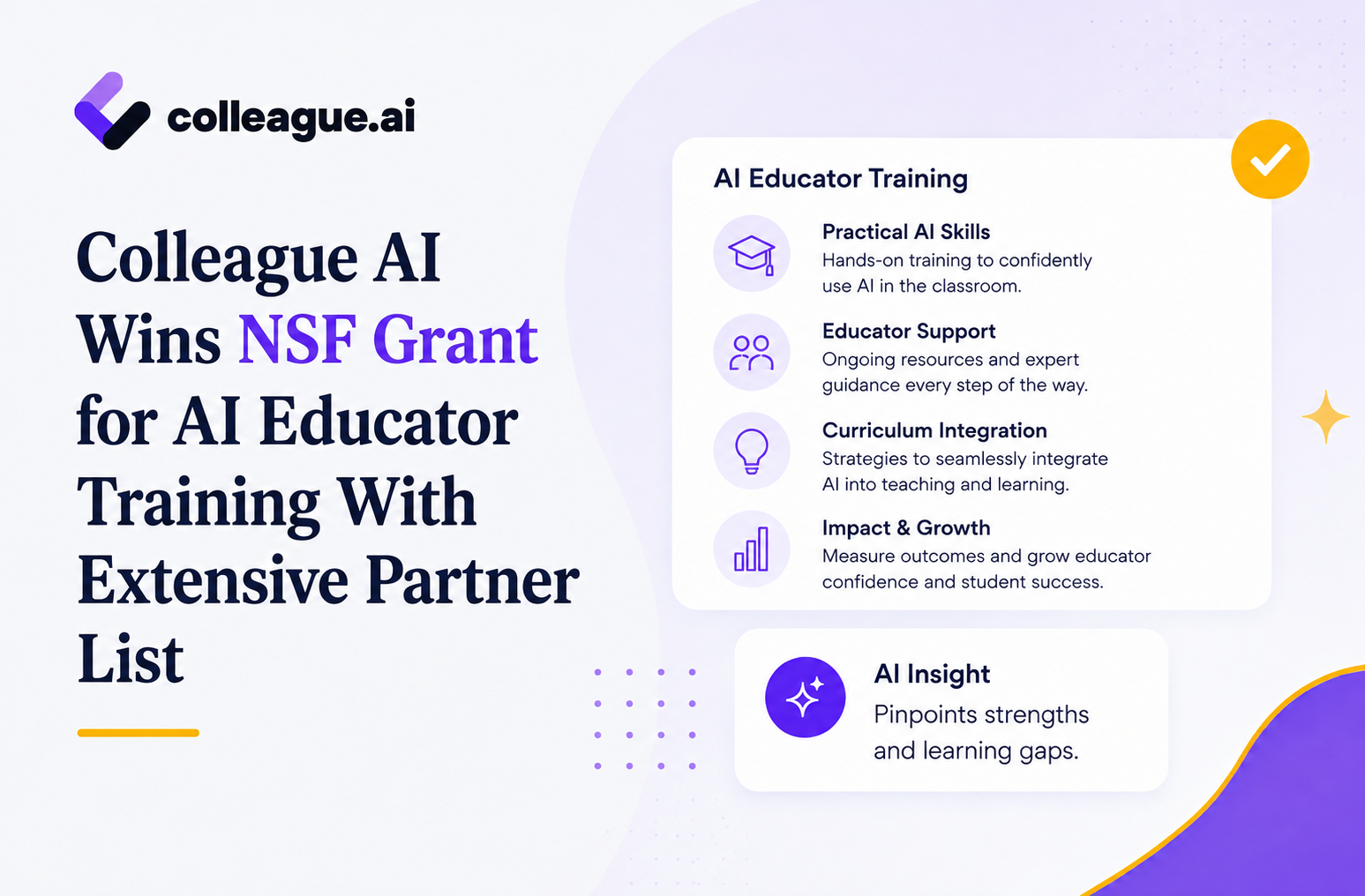
Colleague AI, AmplifyLearn.AI at the University of Washington College of Education, the University of Tennessee at Knoxville, aiEDU, the Minnesota Generative AI Alliance for Education, and a growing list of school districts and regional education service centers have formed a coalition to deliver sustained AI training to educators across the country, backed by a distinguished grant from the National Science Foundation.
A Coalition Built to Reach Thousands of Classrooms, Not a Few Pilot Sites
The initiative is backed by a National Science Foundation grant (award #2405110) awarded under NSF's Discovery Research PreK-12 program, and it sits inside a broader body of federal research funding, over $18 million from NSF, the U.S. Department of Education, and the Institute of Education Sciences, that has shaped how Colleague AI's platform and training approach were built in the first place. The coalition's target is specific and ambitious: more than 240 training sessions reaching approximately 4,800 educators nationwide.
Ten education service centers have already taken part in related federally funded work, which is part of why the group is confident the demand is real rather than assumed. That scale reflects what it actually takes to move AI training from a handful of early-adopter classrooms to nationwide training.
Training That Goes Further Than a Login and a Prompt List
The program is structured around in-person and synchronous training sessions, paired with ready-to-use AI learning materials teachers can bring directly into their lesson planning. It also includes a train-the-trainer model, so districts build internal capacity instead of depending on outside facilitators indefinitely, along with AI Certified Educator (AICE) digital badging and regional networking events where educators across districts can compare notes on what's working.
The training structure reflects a belief that shows up throughout Colleague AI's work (and backed by research): basic AI literacy training isn't enough to responsibly support adoption. Knowing how a tool works is a different skill from knowing how to tell good AI-generated output from bad, when to override it, and how it should actually change the rhythm of a teaching and learning cycle rather than just sitting on top of it. Train-the-trainer and badging exist because a single workshop can introduce a tool, but it can't build the ongoing judgment an educator actually needs. A research center, a university partner, two nonprofits, and a slate of districts all sitting at the same table is what it takes to build training with that kind of staying power.
"This work only happens because of the partners at the table. The more education service centers, school districts, and educators that join us, the further that reach extends."— Dr. Min Sun, CEO and Co-founder, Colleague AI; Director, AmplifyLearn.AI
Why the Research Partners Matter as Much as the Training Itself
The coalition's structure is deliberate. AmplifyLearn.AI, the University of Washington College of Education's national AI research center, and the University of Tennessee at Knoxville aren't brought in to validate the training after the fact; they're part of designing it. aiEDU and the Minnesota Generative AI Alliance for Education bring their own networks of districts and practitioners into the same process, so the sessions middle-grade math teachers actually sit through are shaped by researchers and educators together, not handed down from one side to the other.
NSF grants in the Discovery Research PreK-12 program come with an expectation that goes beyond delivering sessions and counting attendance: the work has to be studied, and the results, including where it falls short for some educators or districts, have to be reported honestly. That's part of why the coalition is built around a research center and two universities rather than a single vendor running workshops on its own. A training initiative aimed at 4,800 educators across dozens of districts only holds up if someone is tracking whether it's actually working, for whom, and adjusting when it isn't.
The Coalition Is Recruiting Interested Districts and Service Centers
Colleague AI is actively looking for additional school districts and regional education service centers to join the grant initiative. Participation is open to any district or service center interested in bringing structured, research-backed AI training to its math educators rather than assembling something ad hoc, including districts that don't yet use Colleague AI's platform, which currently serves more than 250,000 users across 50-plus countries.
Districts and education service centers interested in joining the coalition, or in learning more about how the training sessions, AICE badging, and train-the-trainer model would work locally, can reach out to Colleague AI directly.
Get in Touch About the Initiative