
Feature Highlight ✨
Welcome to your organizational and personal library!
At Colleague AI, we support content rigor and customizable needs.
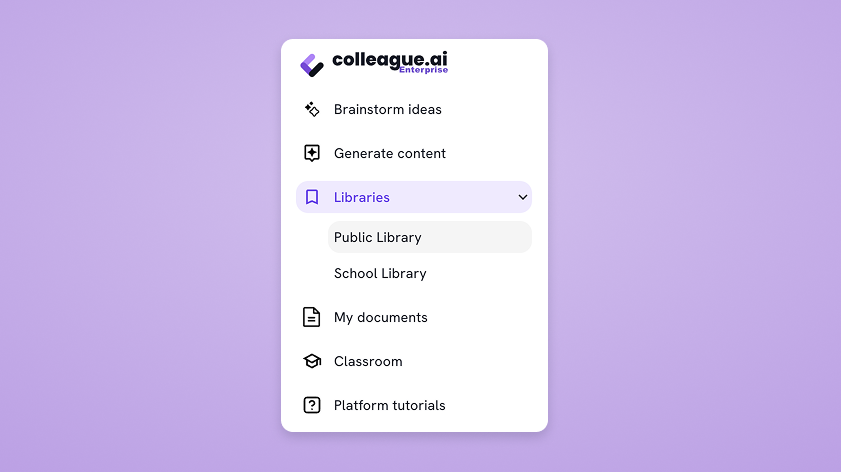
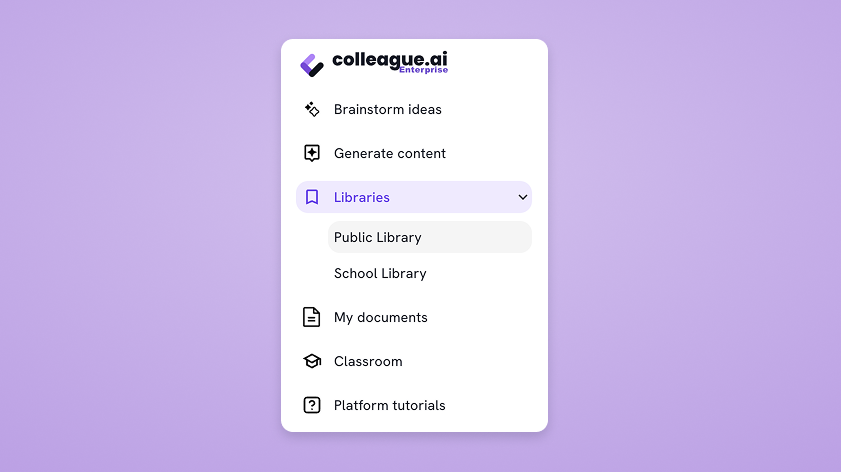
Now with the new “Public Library” and “School Library,” you can find the best of two worlds. Derived from the previous “Find Lessons” feature, the Public Library lets you find high-quality OER lessons from Illustrated Mathematics, OpenSciEd, and more. You can then bring this content to Brainstorm ideas, use it as a template in My Documents to adapt, or generate interactive activities and games based on it.
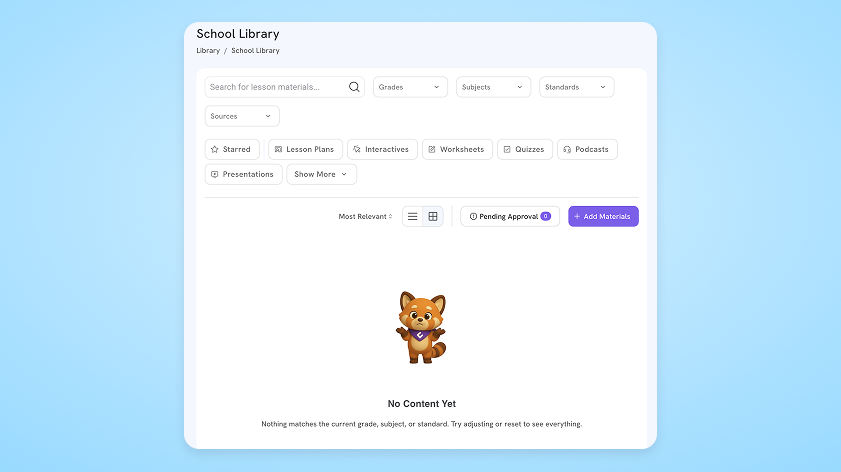
In addition, if your account is under an enterprise license, you can upload materials to the School Library to make them available to your colleagues. This includes materials generated on Colleague AI or documents from your cloud or local drive. Your uploaded materials will be sent to your OrgIT and OrgLeader for approval before publication. Afterward, all your colleagues in your organization can use your content as a template.
Your Milestone 🏅
The AICE Certified Educator Badge
🏅 The AICE Certified Educator Badge, offered by the University of Washington College of Education in collaboration with Colleague AI, recognizes educators who have shown they can use AI as an effective teaching assistant — not just for planning, but for designing impactful lessons, supporting all learners, and modeling safe, responsible use for students.
🚀 Why It Matters
Earning this badge means you’ve built a modern teaching skill set that helps you:
- Save time without lowering quality.
- Reach every learner with customized scaffolding.
- Prepare students for a world where AI is part of everyday learning and work.
This badge shows your school, your colleagues, and your professional network that you are ready to lead in AI-supported teaching.
Our Community 📣
Colleague AI at ASU+GSV
Grateful to have been part of the conversation at the ASU+GSV Summit.
We were proud to bring a practitioner- and educator-centered perspective to the stage, grounded in how AI can meaningfully support teaching and learning in real classrooms.
Colleague AI at ASU+GSV Highlight
Our Co-Founder and CEO, Min Sun, joined Charles Elliott, Chris Clark, Jennifer Lee, and Kavitta Ghai to discuss the future of ambient AI in education.
Dr. Min Sun tackled one of the most pressing questions in EdTech: How do we design systems that empower rather than surveil? As AI becomes the “air” of campus life, how do we scale personalization without eroding agency?
For Colleague AI, the answer is simple: The teacher is the anchor. Data is not collected to monitor — it’s collected to inform.
We give educators a clearer view of where every student stands, and enable teachers to do what they do best: connect with students in meaningful, human ways.
“The human part of this is where I put most of my energy and thinking. I want students to enjoy school, be prepared for the future, and have a fulfilling life.”
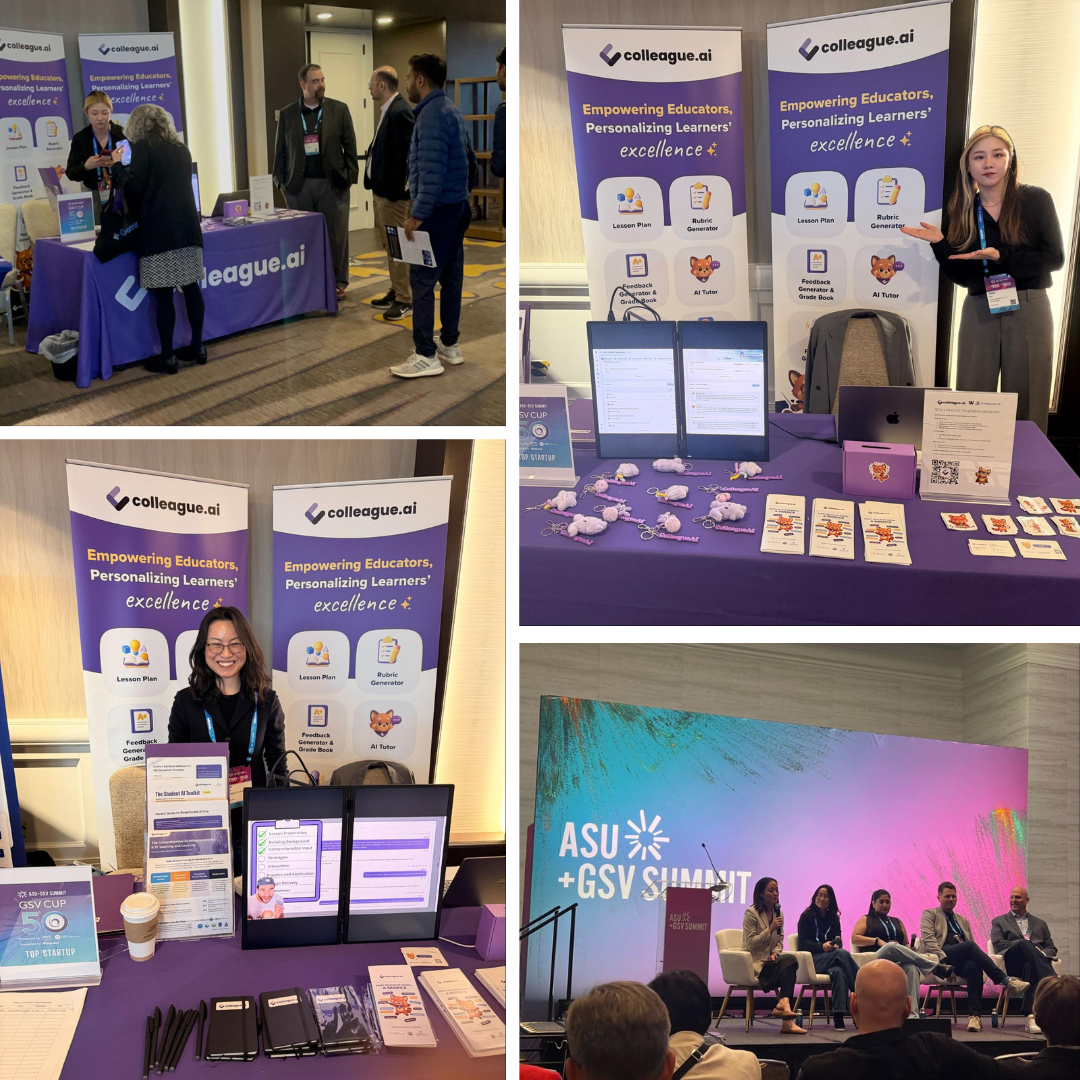
It was also great connecting with so many of you at GSV Demo Day and at Booth #68. We appreciated the thoughtful conversations with educators, leaders, and partners exploring what responsible, classroom-ready AI can look like.
If we didn’t get a chance to connect in San Diego, we’d still love to continue the conversation — feel free to reach out.
Our Research 🔬
Heading to the 2026 NARST Annual International Conference in Seattle, WA?
Join our research partner’s session on How Science Teachers Use AI: A Descriptive Portrait from a National Survey.
Session Time: 8:15–9:45, April 21, 2026
Location: Jefferson B (L4)
Presenter: Dr. Joshua Rosenberg, University of Tennessee, Knoxville, USA
Artificial intelligence is reaching science classrooms, but how teachers use it remains unclear. We report results from a national survey of 566 U.S. public-school science teachers (RAND American Educator Panel, 2025). We defined generative AI as tools that create content or automate tasks using large data patterns.
About half of teachers reported any use of GenAI; roughly one in four use it weekly or daily. Use concentrates on teacher-facing work — planning lessons (40%) and creating assignments or assessments (32%) — with smaller shares for in-class support, differentiation, and routine paperwork. Only 5% said they teach students to use GenAI as a learning tool.
About a quarter said GenAI has changed how they interact with students, most often through more personalization, better support for varied needs, and more ways to explain difficult ideas. Teachers also reported limited student use overall.
Taken together, GenAI currently functions more as a planning assistant than a classroom learning tool. We close by outlining implications for professional learning, classroom-ready resources, and policy.
We value your opinion!
Your feedback helps us make Colleague AI better. Please take 2 minutes to complete our survey.
Take the 2-Minute Survey →