
Colleague AI's
AI and District Leadership Manifesto
For the first time in the history of education technology, your AI purchasing decisions are instructional, strategic & system improvement decisions.
Made at the district level, scaled across every classroom, and standing in front of every parent, every board member, every state auditor. The question superintendents are now being asked — quietly by curriculum directors, community stakeholders, and by their boards — is no longer “Are we doing AI?”, but “What’s your AI strategy, why, and is it enough?”
What’s Categorical Shifts in Education Technology
For thirty years, edtech procurement was a defensive game. Did the LMS hold student work? Did the SIS report enrollment cleanly? Did the analytics platform produce the dashboards the cabinet asked for? None of those tools made instructional decisions. They organized, delivered, or measured the decisions humans had already made.
Large language models and agentic AI have ushered a categorical shift in education technology:
When a teacher uses an AI tool to draft a lesson, the tool’s assumptions about rigor, standards, and learning become the lesson. The platform you approved is in the room every period of every day.
For explanations, feedback, first drafts, second opinions — every day, every grade level. Your only choice is whether what they’re using was chosen with the rigor of an instructional decision or the speed of a software purchase.
The post-school landscape — colleges, employers, the economy your graduates step into — is being rewritten. Are we doing enough to prepare students for an AI-ready workforce? Is our system and instructional choices ensuring cognitive development, not AI offloading?
The Choice of AI Provider Affects the Real Value of LLMs & Agents
The value of AI in K-12 is not in the model. It is not in the chat interface. It is not in any single use case. It is in context.
The value of AI begins when a tool understands this student, in this class, working on this standard, inside this curriculum, in this school, in this district, against this assessment data, alongside this IEP, in front of this teacher — and tied to this school improvement plan and this budget reality.
That depth cannot be assembled by an LLM-wrapped. It cannot be approximated by 10 different AI tools each holding a slice. It requires a comprehensive platform.
Colleague AI’s AI for School Districts Manifesto

AI procurement is instructional and strategic procurement.
A PO for AI is a curriculum decision, a pedagogical decision, an instructional decision, a school improvement decision.

A defensible AI strategy requires a defensible platform.
Colleague AI is committed to a platform district leaders can stand behind: with the guardrails that keep students and data safe, the embedded workflows that make the right thing the default, and the standardized-and-decentralized options that let a district set the floor while schools and teachers retain the room to adapt.
Context is the product.
AI’s value comes from the depth of context it holds — student, classroom, school, district, curriculum, standards, assessments, plans. A tool with no context is a worksheet generator with a chat box.

AI tool fragmentation is the enemy of scale.
One-off tools cannot deliver high-impact value, especially for medium to large school districts. A tool for teachers is not a strategy. Five disconnected AI tools adds privacy reviews, training overhead, instructional drift, and integration debt. Districts that accumulate lose.
The bar is district outcomes.
AI choices must work for all students, at a high confidence level, lest they raise questions on equity. AI should help with a district’s key outcomes: student growth and learning, teacher retention, school improvement, budget ROI, AI-ready graduates. That is the only scorecard that matters, not productivity.
AI implementation, rollout, training and adoption are absolutely fundamental.
In a new era, we can’t assume equal AI competency across district employees. Rigorous training and implementation is key to helping ensure AI supports your instruction, school improvement, and district policies.
Superintendents Are Accountable on AI Decisions
With such a high-profile topic, the choices and decisions around AI are inevitable for superintendents today. The questions around the choices are changing towards defensibility:
- How do our AI choices impact students, teachers, schools, instruction, efficiency, resources, etc.?
- What are the guardrails and embedded workflows that govern AI use?
- What do we standardize, and what do we decentralize? Where does the district set the floor, and where do schools and teachers have room to adapt?
- How are we preparing AI-ready graduates? What does it mean to leave our district fluent, capable, and competitive in a world where AI is the medium of work?
- Who is accountable when something goes wrong?
Our goal is to provide a district-ready, research-backed, integration-friendly, comprehensive AI platform with unmovable roots in:
- K-12 education research
- Instructional rigor
- Co-design with superintendents, school district leaders, administrators
- Focusing on your goals, not siloed productivity or single-use tools
- Providing extensive and rigorous training to help with AI implementation, rollouts, and strong adoption
It’s our belief that Superintendents should be able to defend their AI choices and answer questions coming from the board, parents, school principals, and other stakeholders. Most AI vendors can’t do this.
If we get this wrong, AI will be remembered as the technology that made instruction faster and learning shallower.
If we get this right, AI will be remembered as the technology that finally let every teacher meet every student where they are — with the full context of who they are, what they have learned, and what they need next.
Unlimited AI Tools for Administrators
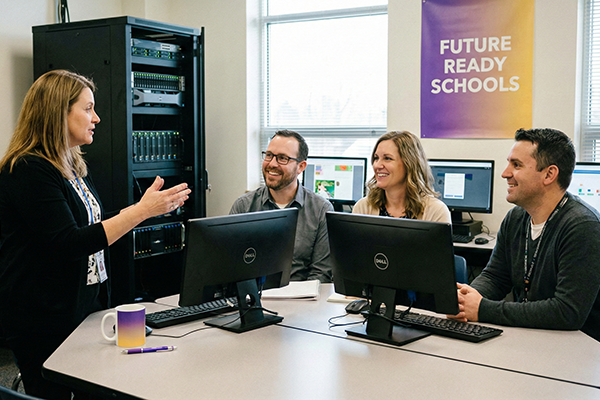
AI isn’t just useful for teachers – it can be invaluable for administrators too. Check out some of our AI tools for school admins.

Custom AI for Your Schools
From giving our AI models your own school and district documents, to memory that knows you and your students.

Questions? Contact Us!
To speak with a member of the Colleague AI team, or if you have questions, contact us.