
Colleague AI's
AI & Curriculum Manifesto
For the first time in the history of education technology, software is making instructional decisions.
Not recommending. Not surfacing. Deciding.
When a teacher asks an AI tool to build a lesson plan, draft a unit assessment, scaffold a reading task, or differentiate for a student with an IEP, the tool’s underlying assumptions — about rigor, about standards, about what learning looks like — become the lesson, the assessment, the scaffold. And when a student opens an AI tool of their own, the same is true in reverse.
Poor AI tools lose improvement cycles, instructional rigor, and coherent curriculum and practices.
What’s Changed
Education technology, until now, has been tools for education, controlled by people – LMSs, data analytics, SISs, ERPs, etc. None of these tools made instructional decisions.
Large language models and agentic AI broke that pattern.
The shift is not incremental — it is categorical:
When AI drafts a lesson, it is not a blank template. It is a position on rigor, on prerequisite knowledge, on what counts as evidence of understanding. Every output ships with a pedagogy attached.
Students use it for explanations, for feedback, for first drafts, for second opinions — whether educators ask, encourage, or forbid it. AI is in the learning process. The only question is whether it is in the learning process well.
The platform has become the pedagogue. The instructional choices baked into a model — by its training, its prompts, its scaffolding, its connected data — show up in classrooms as the choices teachers and students appear to be making.
Instructional Decisions Matter
Most AI tools entering schools were not built with curriculum directors in the room. They were built for speed and ease for individual teachers — a sensible design goal in isolation, and a dangerous one at scale.
When millions of instructional decisions are quietly delegated to systems optimized for output volume rather than instructional quality, the result is a slow, uneven flattening:
- Lesson plans converge toward a generic mean
- Assessments mistake recall for understanding
- Differentiation becomes surface-level rewording,
And ultimately, the students are the ones who bear the cost of the AI platform choices made by adults.
The schools that will get AI right are not the ones that adopt the most tools. They are the ones that ask the right question before adoption: Whose pedagogy is this?
Colleague AI’s AI in Curriculum Manifesto

The instructional framework must lead.
Teacher efficiency is a benefit, not a goal. AI that saves time but degrades instruction is a net loss to students.
Context is the product.
The value of an LLM in education is not its general intelligence; it is its capacity to take in the specific student, the specific class, the specific standard, the specific curriculum, the specific school, the specific community — and respond accordingly. An AI tool with no context is a worksheet generator with a chat box.

Siloed AI cannot meet this bar.
Everything we do is ultimately geared towards enhancing students’ academic achievement, critical thinking skills, social emotional health, and overall Tools that see only the prompt in front of them — disconnected from the curriculum, the assessment system, the IEP, the standard, the prior unit — produce work that looks instructional and isn’t. The architecture matters as much as the model. experience. We measure our success by the tangible improvements in student growth.

AI implements your learning standards, not ignores them.
Models trained on the open internet have absorbed more bad pedagogy than good. Without explicit grounding in standards, evidence-based instructional practice, and validated curricula, AI will default to whatever was most repeated online. That is not a curriculum.
Teachers must remain the instructional agency.
AI should make a teacher’s expertise more visible, more leveraged, and more transferable across the day — never less central to the work. It should be clear what the AI is doing, what it’s drawing on, and where its outputs come from.
The end-outcome is student learning.
Not engagement metrics. Not adoption numbers. Not time saved. Did students learn more, learn deeper, and learn what the standards demand? That is the only measure that matters. It’s also why we do so much research.
The Choice of AI Tools Matters
A generation of students is about to learn alongside AI for the entirety of their schooling. The instructional architecture they encounter — every day, in every classroom, across every subject — will shape not only what they know but how they meaningfully contribute to the AI-powered economy.
If we get this wrong, AI will be remembered as the technology that made instruction faster and learning shallower.
If we get this right, AI will be remembered as the technology that finally let every teacher meet every student where they are — with the full context of who they are, what they have learned, and what they need next.
The difference between those two futures is not the model. It is the architecture, the context, the standards, and the people who built the tools.
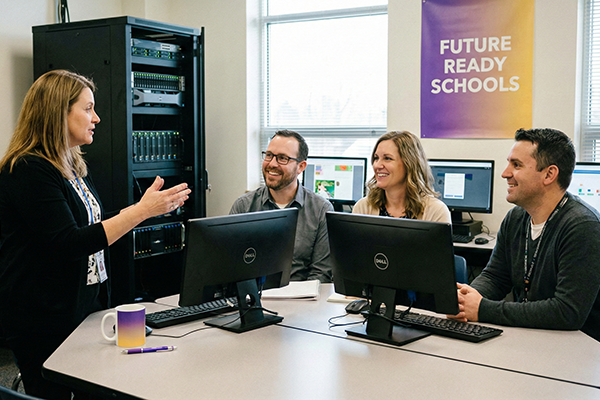
Unlimited AI Tools for Administrators
AI isn’t just useful for teachers – it can be invaluable for administrators too. Check out some of our AI tools for school admins.

Custom AI for Your Schools
From giving our AI models your own school and district documents, to memory that knows you and your students.

Questions? Contact Us!
To speak with a member of the Colleague AI team, or if you have questions, contact us.