
In the last few months, as I’ve started more conversations with investors, I keep hearing the same familiar refrain: “EdTech is not traditionally an attractive industry for investors.”
This sentiment feels increasingly contradictory to the world we’re living in—one where AI is driving unprecedented excitement, market activity, capital inflow and even national security.
In 2025 alone:
- Nearly 70% of venture capital (VC) investment in North America flowed into AI-related companies, and AI companies attracted about 53% of global VC dollars (Bloomberg.com, October, 2025).
- Worldwide AI spending is projected to total approximately $1.5 trillion in 2025, and according to a September 2025 forecast by Gartner.
- The S&P 500’s 2025 market growth is overwhelmingly concentrated in AI-driven firms; Nvidia and other AI hyperscaler companies (such as Microsoft, Google, Amazon) have added trillions in market value within months (Companies Market Cap, 2025).
AI is the economic story of our time.
And yet—education, the very engine that produces the AI-literate workforce society depends on, remains underfunded, misunderstood, and often dismissed.
If we are not enthusiastic about investing in education—especially AI-powered learning innovation—how do we expect to power the AI ecosystem that depends on human capital? And if we are simultaneously concerned about the risks or “AI doom” narratives, how can we combat them without doubling down on human intelligence development, supercharged by AI?
These contradictions have been sitting with me. I cannot stop thinking about it and trying to reconcile them in my own mind. The rest of this piece is my attempt to articulate what I’ve learned: why EdTech has historically been unattractive to investors—and why AI may finally rewrite the story.

Why Has EdTech Been Unattractive to Investors?
Reason 1. The Challenge of Measuring Return on Investment (ROI) in EdTech
One of the core reasons EdTech has traditionally been a tough sell for investors is that it’s hard to measure the return on investment. This challenge exists both at the individual level and at the institutional level. At the individual level, investors have struggled to see clear, timely evidence of how an EdTech product impacts a student’s long-term learning outcomes and future workforce readiness. Traditional measures, such as standardized multiple-choice assessments, capture only narrow slices of student knowledge and skills. These often fail to reflect deeper, future-critical competencies like problem-solving, deep thinking, collaboration, or verbal expression. And because the true benefits of educational investments unfold over many years of a student’s life, there has historically been no fast or reliable way to quantify ROI.
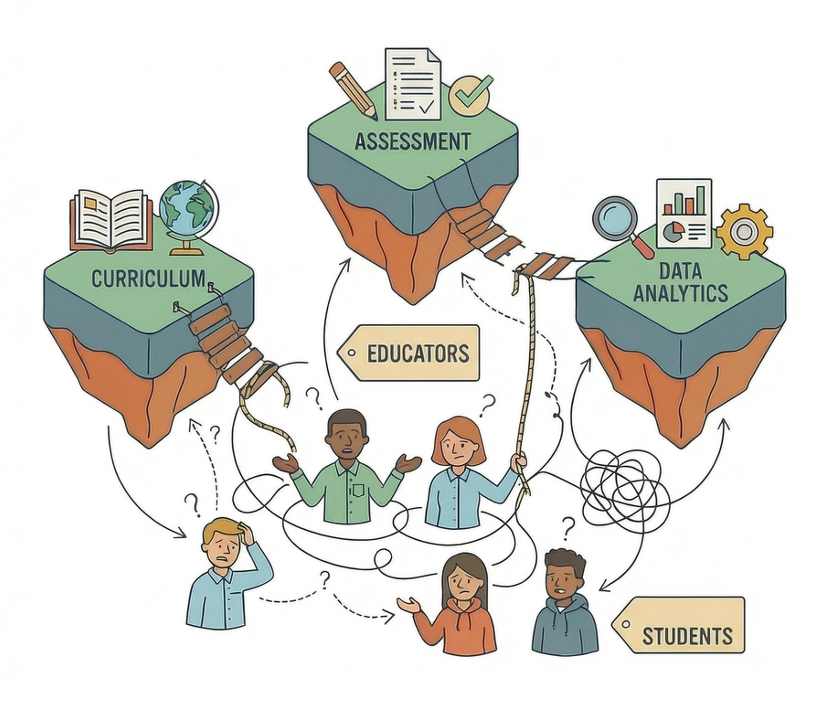
The ROI for school districts has also been difficult to measure. School systems are slow to change and very complex. Educators have already been overwhelmed and are often resistant to new tools that do not fundamentally transform teaching or improve their work efficiency. Moreover, the traditional EdTech innovations in curriculum, assessment, and data analytics are often siloed, forcing teachers to manually stitch together information to support student learning. This complexity has slowed improvement and made ROI on new tools unclear.
Reason 2. The Long Sales Cycle in EdTech
Another longstanding barrier for investors is the notoriously long and intricate EdTech sales cycle. School districts operate on annual or multi-year budgeting calendars, involve layers of decision-makers, and require extensive vetting for compliance, procurement, and evaluation. Even if a product is strong, it can take 6–18 months (or longer) from initial interest to full district adoption. This slow pace contrasts sharply with the speed at which investors expect returns, making EdTech a less appealing category for traditional venture investment.
Reason 3. The Complexity of the Policy and Regulatory Landscape
The education sector is deeply influenced by a complex web of policies, regulations, and compliance obligations. Investors unfamiliar with K–12 often struggle to grasp requirements around student data privacy (e.g., FERPA, state-specific laws), accessibility, equitable access, safety mandates, and alignment to state standards. Entrepreneurs not deeply embedded in the education sector similarly face steep learning curves. To bring a new EdTech product to market, it is not enough to build something innovative—it must also integrate into teaching and learning workflows and meet regulatory requirements at every level. This created uncertainty for investors.
AI Changes Everything.
Shift 1. AI Enables Individual and Organizational Level ROI Measurement.
AI transforms classroom assessment. Instead of relying on limited standardized tests, AI enables consistent, scalable measurement of skills educators have long valued but struggled to quantify—such as students’ problem-solving abilities, deep-thinking skills, and verbal expression. These richer forms of assessment can be captured continuously through classroom interactions, assignments, and real-time learning tasks. With AI’s assistance, students also learn these future-ready skills faster, which makes the individual ROI become visible and trackable.
At the institutional level, AI adoption is more straightforward than prior generation’s technology, because it is intuitive for educators and learners to use their natural language to interact with the technology. Teachers and administrators experienced immediate gains in ROI, for example, reducing workload, improved work efficiency, and accelerating feedback cycles. At the same time, AI can help schools better articulate and communicate the ROIs to their stakeholders, such as parents, school boards, and local voters. These accelerated and visible improvements begin to shift the perception that ROI in school systems is slow, diffuse, or hard to quantify.
Shift 2. AI Breaks Down Traditional Silos in Teaching and Learning
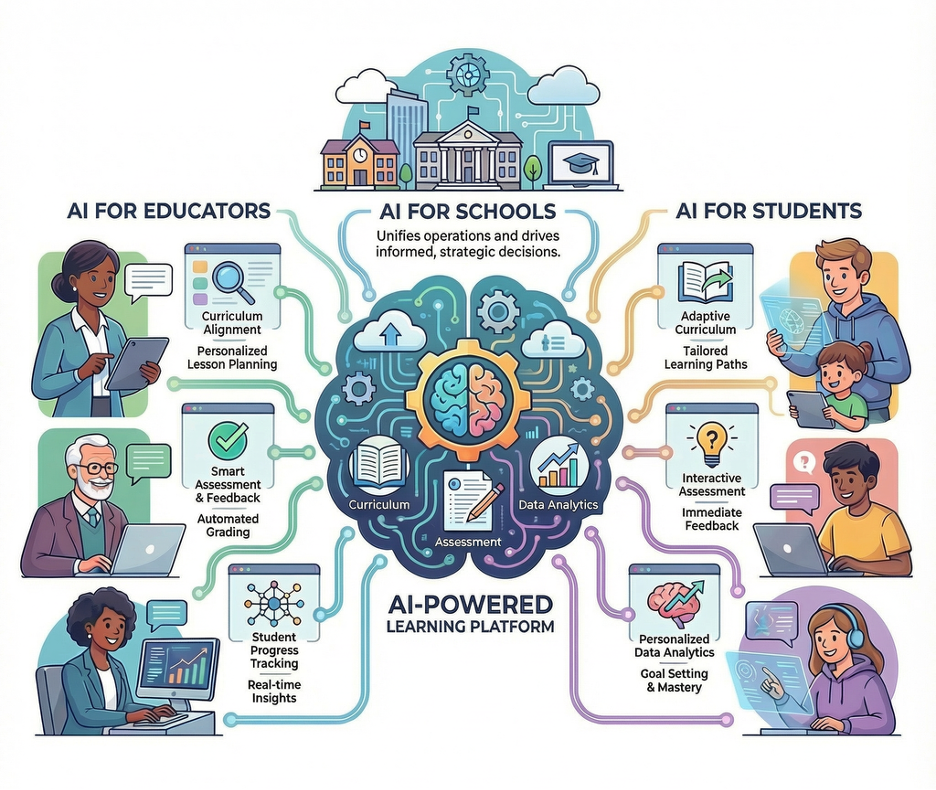
AI resolves one of the most entrenched structural challenges in EdTech–integrating the siloing of curriculum, assessment, and data analytics into one unified system. By these three components together, AI enables coherent instructional workflows, makes personalized learning from an aspiration to reality, and frees teachers to focus on high-leverage human interactions with students. This unified approach makes it more likely to generate faster, more measurable student learning outcomes—which improves the clarity of school-system ROI.
Shift 3. AI Breaks Down School System Barriers and Broaden Revenue Channels
As AI reshapes learning and school operations, will some of the traditional barriers that made EdTech unattractive to investors begin to fall? AI has the potential to shorten sales cycles by allowing schools to pilot tools quickly and see results faster. It can mitigate measurement challenges by generating real-time evidence of learning and efficiency. It can simplify regulatory compliance through automated checks and better data infrastructure. More importantly, because of the consolidation of many functions into one platform, AI can significantly reduce the cost compared to traditional investment. It can shift education toward a more integrated and flexible learning ecosystem, where technology adoption becomes more natural and ROI more apparent.
More importantly, AI is blurring the lines between formal and informal learning, K-12 and post secondary education, and workforce development. AI introduces new trends that are beginning to reshape the structure of learning itself. AI-powered tools make education more personalized and more flexible, enabling learning to move fluidly between formal school environments and informal learning settings (home, after-school programs, tutoring, enrichment platforms). It also makes K-12 education, post secondary, and workforce training more fluid. This flexibility challenges the traditional assumptions that EdTech tools only operate inside the formal K–12 system or via a B2B model. As learning increasingly extends across multiple contexts, AI may weaken some of the historical barriers—like rigid school calendars or siloed learning environments. This will increase the rate of return on investments for investors and broaden the market size.
Conclusion: A Call to Action
AI is poised to transform teaching and learning. But this transformation is not automatic. It requires vision, it requires innovation, and it requires investment. If the broader enthusiasm for AI is not matched by investment in learning technology development, then the rest of society’s excitement is unfounded. We cannot build the AI-powered future without investing in the human intelligence that fuels it; otherwise, I would be very concerned by the AI Doom narrative.
EdTech is not a peripheral sector; rather, it is the foundation of every industry the AI revolution will touch. Now is the moment for us—as innovators, investors, and policymakers—to invest with the urgency this moment demands.